

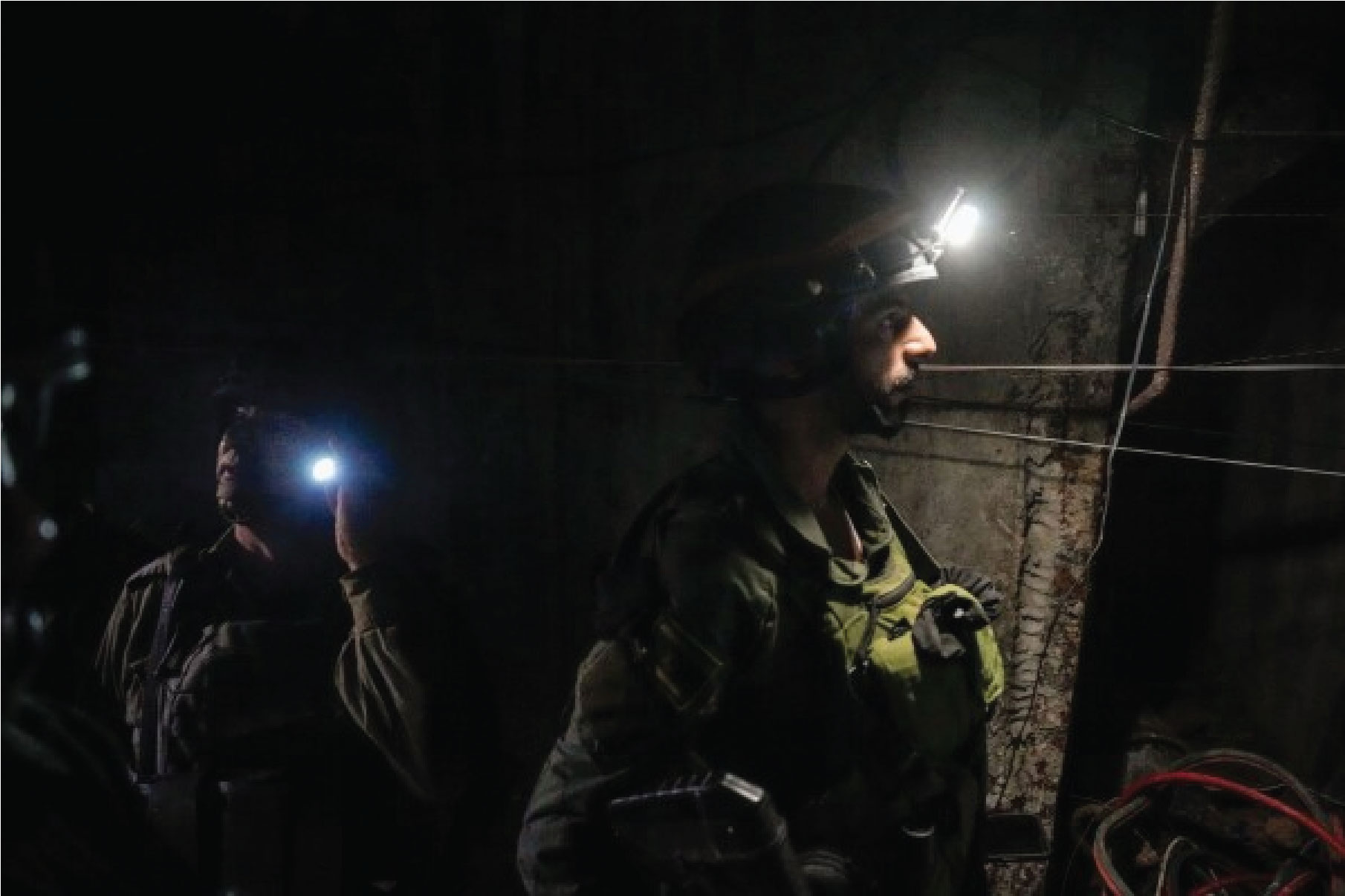
The Israeli military announced on Sunday the discovery of a significant tunnel shaft in Gaza, situated near the former busy crossing into Israel. This revelation has sparked concerns about how Israeli surveillance may have overlooked the conspicuous preparations made by Hamas leading up to the militant’s deadly Oct. 7 assault.
The tunnel’s entrance is merely a few hundred meters from the heavily fortified Erez crossing and an adjacent Israeli military base. Notably, it stands as the largest and longest tunnel uncovered by Israeli forces to date, spanning over 2.5 miles and connecting to an extensive tunnel network across Gaza. The tunnel is reportedly wide enough to accommodate vehicles, enabling the transit of cars, militants, and supplies in preparation for the Oct. 7 attack, according to the Israeli military. Constructed from reinforced concrete and steel, the tunnel also served as a means for Hamas militants to transport hostages during the Oct. 7 incident, as reported by Israeli forces.
On that fateful day, militants utilized a rocket-propelled grenade to breach a section of the wall near the Erez crossing, storming the base and causing the death of at least three soldiers. They also kidnapped some individuals back to Gaza. This incident was one of multiple breaches along the border wall, where militants successfully overcame Israel’s security defenses, infiltrated Israeli territory, resulting in approximately 1,200 casualties and around 240 individuals being taken hostage.
The aftermath triggered a devastating 10-week war, claiming over 18,000 lives in the Hamas-ruled Gaza Strip, as reported by Palestinian health officials. Israel has identified the destruction of Hamas’ tunnel network as a significant objective, emphasizing that much of the underground infrastructure is concealed beneath schools, hospitals, and residential areas. The Israeli military
Israel’s military, intelligence, and political entities have faced substantial criticism for their failure to anticipate the attack. Major Nir Dinar, a military spokesperson, stated that Israeli security services were unaware of the tunnel before Oct. 7, explaining that Israel’s border defenses typically detect tunnels intending to enter Israel. The tunnel’s entrance, with a circular cement opening leading to a concealed passageway, was situated under a garage, making it elusive to Israeli drones and satellite images, according to Dinar.