

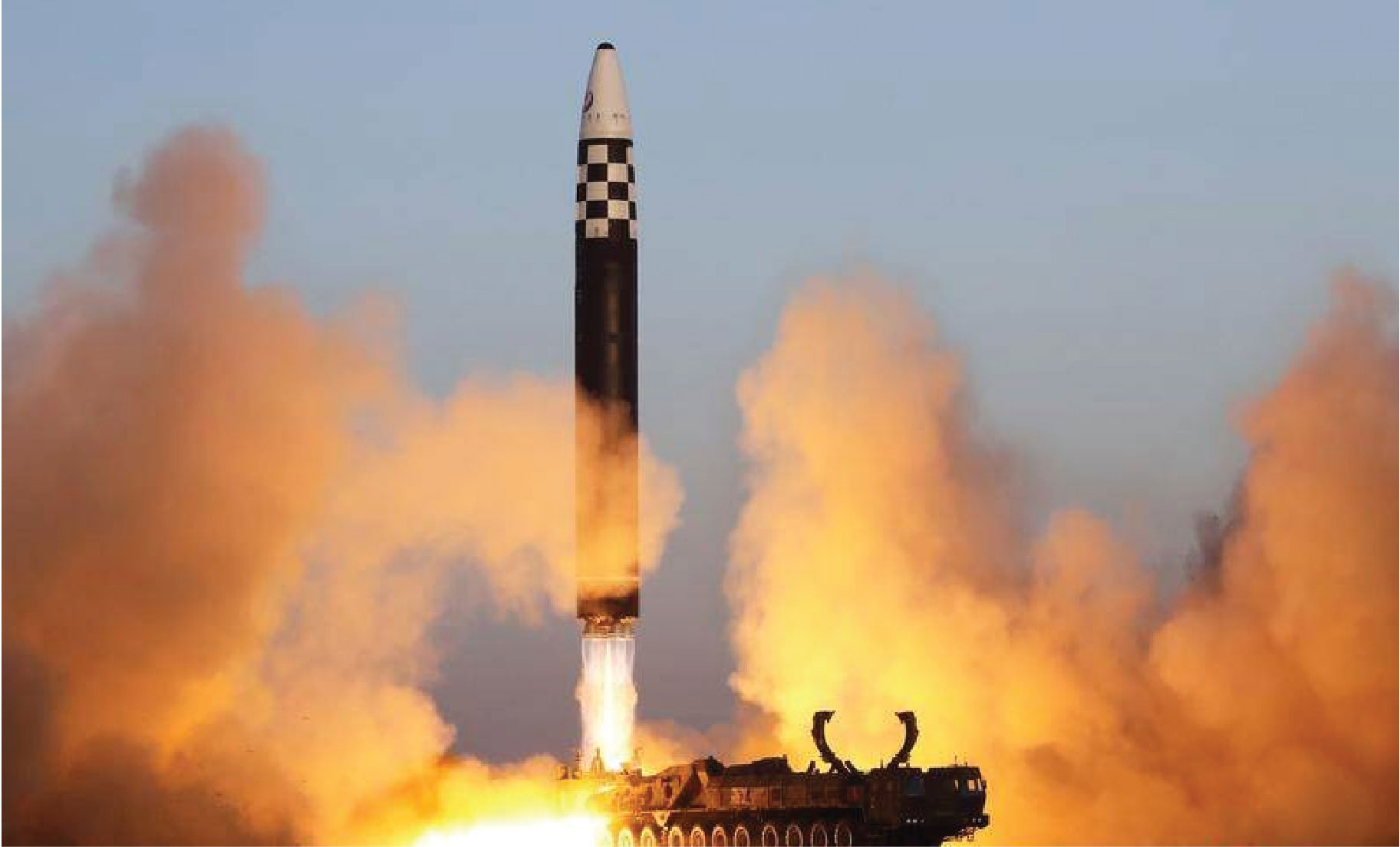
On Monday, North Korea conducted its first intercontinental ballistic missile (ICBM) test in five months, unveiling a likely developmental and more agile weapon. This move follows North Korea’s declaration of strong responses against U.S. and South Korean efforts to enhance their nuclear deterrence plans.
The South Korean government characterized the tested missile as a solid-fueled weapon, likely referring to the North’s road-mobile Hwasong-18 ICBM. The Hwasong-18 utilizes built-in solid propellants, making its launch less detectable by adversaries compared to liquid-fueled weapons. North Korean leader Kim Jong Un has previously touted the Hwasong-18 as the most potent weapon within his nuclear arsenal.
South Korea’s military reported that the North Korean missile covered approximately 1,000 kilometers (620 miles) before landing in the waters between the Korean Peninsula and Japan. The missile was launched at an elevated angle, seemingly an effort to avoid affecting neighboring countries. According to Japanese lawmaker Masahisa Sato, citing Japan’s Defense Ministry, the missile reached an altitude of as high as 6,000 kilometers (3,730 miles).
The reported flight details matched those of North Korea’s second test of the Hwasong-18 missile in July. The North first test-fired the missile in April. North Korea conducted
Since 2017, North Korea has engaged in numerous intercontinental ballistic missile (ICBM) tests with the goal of acquiring the capability to launch nuclear strikes on the U.S. mainland. However, all of its tests preceding the April launch of the Hwasong-18 involved liquid-propellant ICBMs. These liquid-propellant missiles require fueling shortly before launch and cannot remain fueled for extended periods. In contrast, the Hwasong-18, described as a solid-fueled weapon in recent reports, represents a shift in North Korea’s missile development strategy. Solid-fueled missiles are known for their mobility and the ability to be launched quickly, making them less susceptible to pre-launch detection by adversaries compared to their liquid-fueled counterparts.