

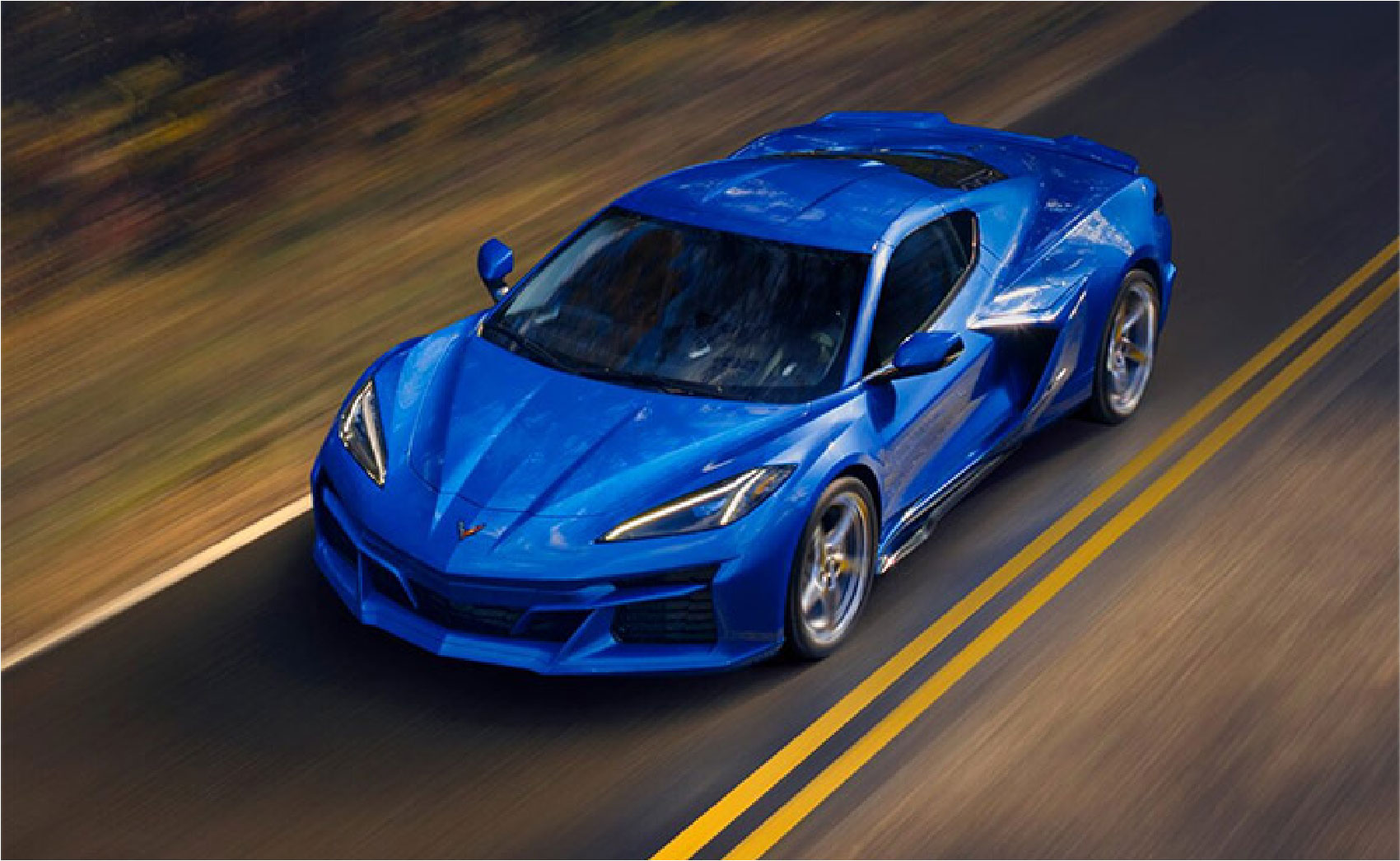
The Corvette Transitions from the Gasoline Era to Electrification with the E-Ray, a Hybrid Designed for Enhanced Speed, Not Extended Range, on Every Fuel Fill-up.
In the words of Charles Darwin, adaptation is key for survival. This principle isn’t exclusive to the natural world but extends to the automotive realm. Take the Corvette, for instance. In its quest to remain relevant.And the Corvette underwent a significant transformation in 2020 with the introduction of the C8 generation. This marked a departure from its previous iterations as the engine shifted to a rear position. And making it reminiscent of an Italian supercar.
The C8’s evolution continued with the Z06, featuring a naturally aspirated flat-plane-crank V-8 engine. That emitted a visceral roar akin to something that could have originated from a Ferrari dyno cell. Now, the next stage in the C8’s evolution unfolds with the 2024 E-Ray. It introduces a hybrid powertrain, all-wheel drive. And standard all-season tires, further blurring the line between it and a four-season supercar. And don’t fret about it sacrificing performance in the name of fuel efficiency; it remains incredibly fast, pushing the boundaries of speed.
Differing from the growing cohort of plug-in hybrid supercars like the Ferrari 296GTB and McLaren Artura. The E-Ray stands apart by not having a plug-in option, and its electric motor primarily serves as a performance booster rather than an efficiency enhancer. The E-Ray’s genetic blueprint draws from both the base Stingray and the Z06. Not Extended Range
The Stingray contributes its robust 495-horsepower pushrod 6.2-liter V-8 engine, performance-oriented exhaust system, and an eight-speed dual-clutch automatic transmission. Meanwhile, the Z06 imparts its broader body design, the choice of carbon-ceramic brakes, and substantial tires that resemble steamrollers – 275/30ZR-20 for the front and 345/25ZR-21 for the rear. The hybrid system is composed of a compact electric motor powering the front wheels. Discreetly situated in a small space ahead of the passenger compartment. Additionally, there’s a 1.1-kilowatt-hour battery discreetly nestled in the tunnel running between the passengers. This configuration is complemented by supplementary cooling mechanisms to regulate battery temperature. And the requisite software to orchestrate the entire system seamlessly.