

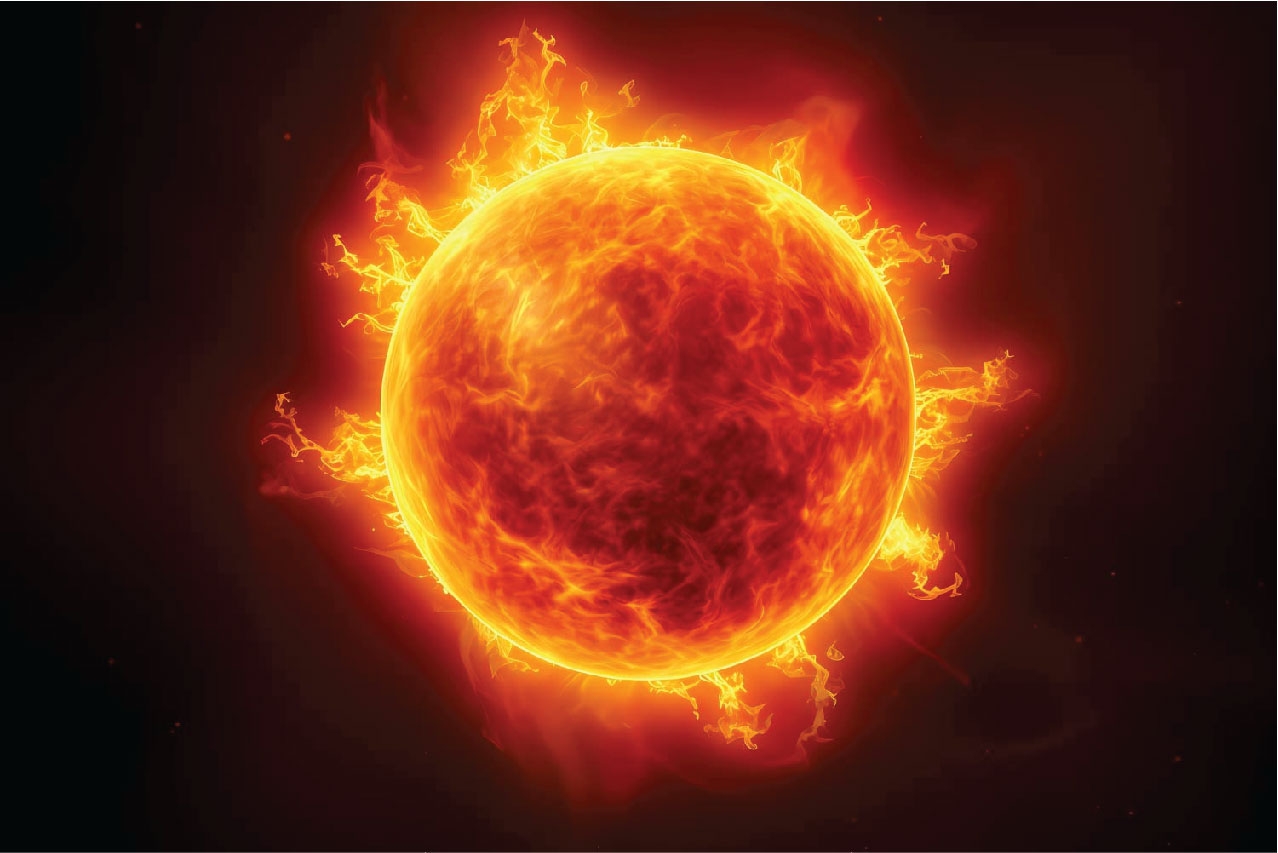
On New Year’s Eve, a significant solar flare the largest in years, was observed on the sun, leading to a cautionary message for certain high-frequency radio users.
The National Oceanic and Atmospheric Administration’s Space Weather Prediction Center (SWPC) provided an update on Sunday evening, unveiling an image of the flare. This solar event manifested as a sizable, luminous spot on the sun, raising awareness about potential impacts on high-frequency radio communication systems. a significant solar flare
“A flare is an eruption of energy from the sun that generally lasts minutes to hours,” the SWPC explains. This one in particular, which peaked just before 5 p.m. ET on Sunday, was categorized as an X5 flare.
Solar flares are classified based on their strength, much like earthquakes, according to NASA. The scale ranges from B-class on the lowest end to C-class, then M-class, and finally, X-class. Each letter represents a ten-fold increase in energy output, and there is a scale of 1 to 9 in each class, except for X-class. X-class flares can exceed 9, with the largest-ever recorded being an X45 that occurred in 2003.
Solar flares are classified based on their strength. Flares with B- or C-class ratings are too weak to be noticeable on Earth. M-class flares can cause brief radio blackouts at the poles and minor radiation storms that might affect astronauts. X-class flares, on the other hand, can have more significant impacts. They can cause radiation storms affecting satellites, deliver small radiation doses to airplane passengers near the poles, and even lead to global transmission issues and worldwide blackouts.
The recent flare observed on New Year’s Eve was categorized as an X5, making it smaller than the notable 2003 flare but the most powerful since September 2017 when an X8.2 flare was recorded. This event also surpassed a previous X2.8 solar flare reported in the same sun region on December 14. During that time, the Space Weather Prediction Center noted it was “likely one of the largest solar radio events ever recorded.”