

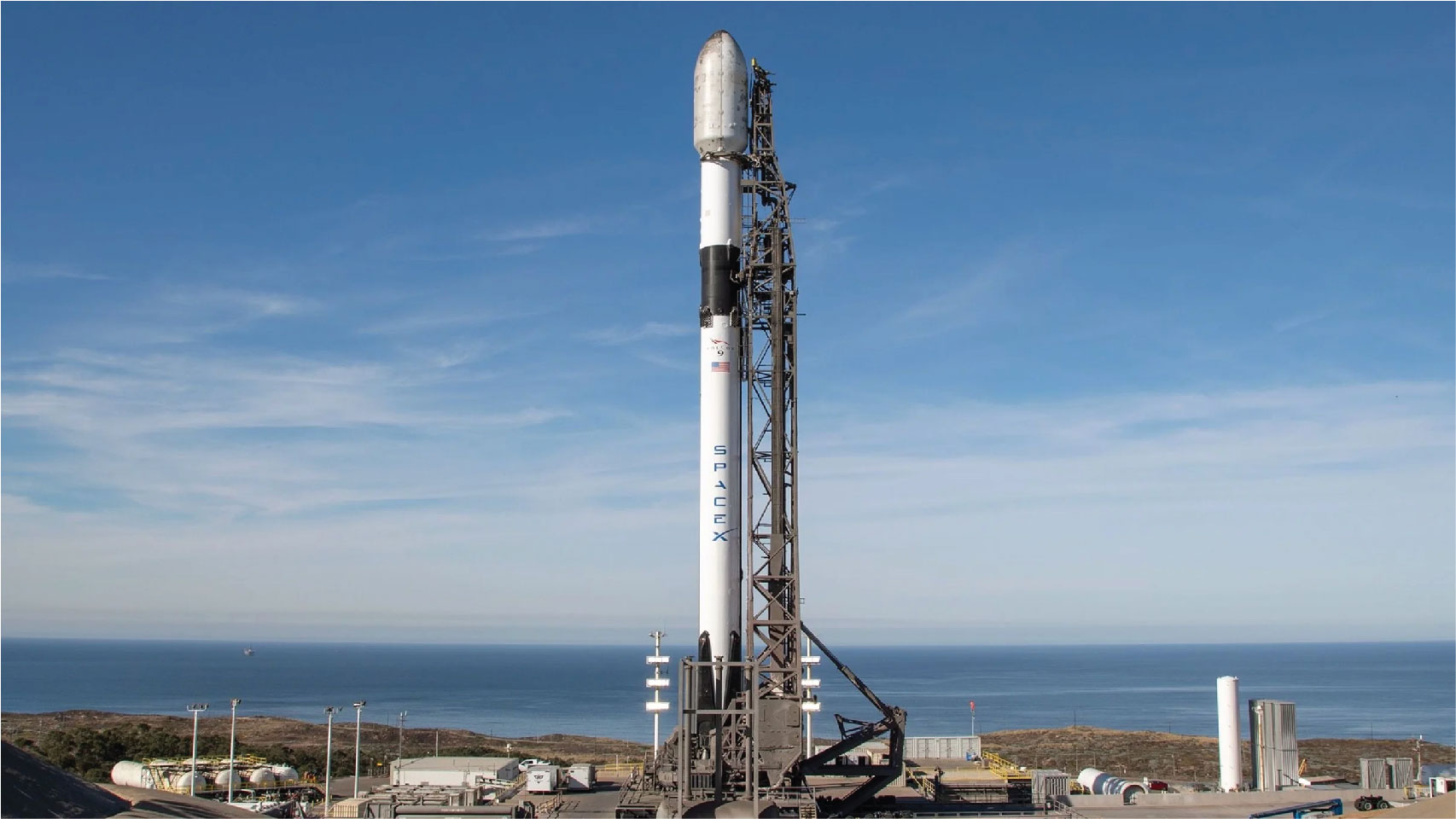
SpaceX is swiftly initiating what is anticipated to be an exceptionally active year for orbital launches. The company commenced the year with the launch of its reliable Falcon 9 rocket on a Starlink satellite mission on Tuesday night.
The liftoff took place at 7:44 p.m. PST (10:44 p.m. EST, 0344 UTC) from Space Launch Complex 4 East (SLC-4E) at Vandenberg Space Force Base in California. The payload for this launch included 21 Starlink satellites, with the first six featuring direct-to-cell capabilities. This mission is part of SpaceX’s ongoing efforts to expand its Starlink satellite constellation, which aims to provide global broadband internet coverage.
The recent Starlink satellite mission by SpaceX, originally scheduled for mid-December, faced undisclosed issues that led to its postponement. However, the launch successfully took place on Tuesday night.
The mission included the deployment of 21 Starlink satellites, with the notable addition of the first six satellites featuring direct-to-cell (DTC) capabilities. According to SpaceX, the integration of DTC aims to empower mobile network operators globally to offer seamless access to texting, calling, and browsing, even in areas with challenging connectivity. SpaceX is swiftly initiating
SpaceX founder Elon Musk emphasized the significance of this addition during an event in August 2022, where he and T-Mobile CEO Mike Sievert discussed the technology. Musk described DTC as a “massive game changer” that could eliminate dead zones worldwide. He highlighted its resilience, stating that even in scenarios where natural disasters take out conventional cell towers, phones with DTC-enabled satellites would still maintain connectivity.
According to a Nov. 30, 2023, email sent to Kathyrn Medley, the acting division chief of the Federal Communication’s (FCC) Satellite Licensing Division, SpaceX anticipates launching “approximately 840 direct-to-cell capable satellites over the next 6 months, with additional launches continuing after that period.”
Jameson Dempsey, SpaceX’s director of satellite policy and the author of the email, wrote that the planned and future launches would “ensure that we can launch a critical mass of satellites in time to deliver commercial service later in 2024.”
“As such, while we understand that the Commission may limit our experimental authority to the satellites we expect to launch and testing the next 6 months, we request that the launch license include authority for all 7500 satellites in our direct-to-cell modification application,” Dempsey wrote.