

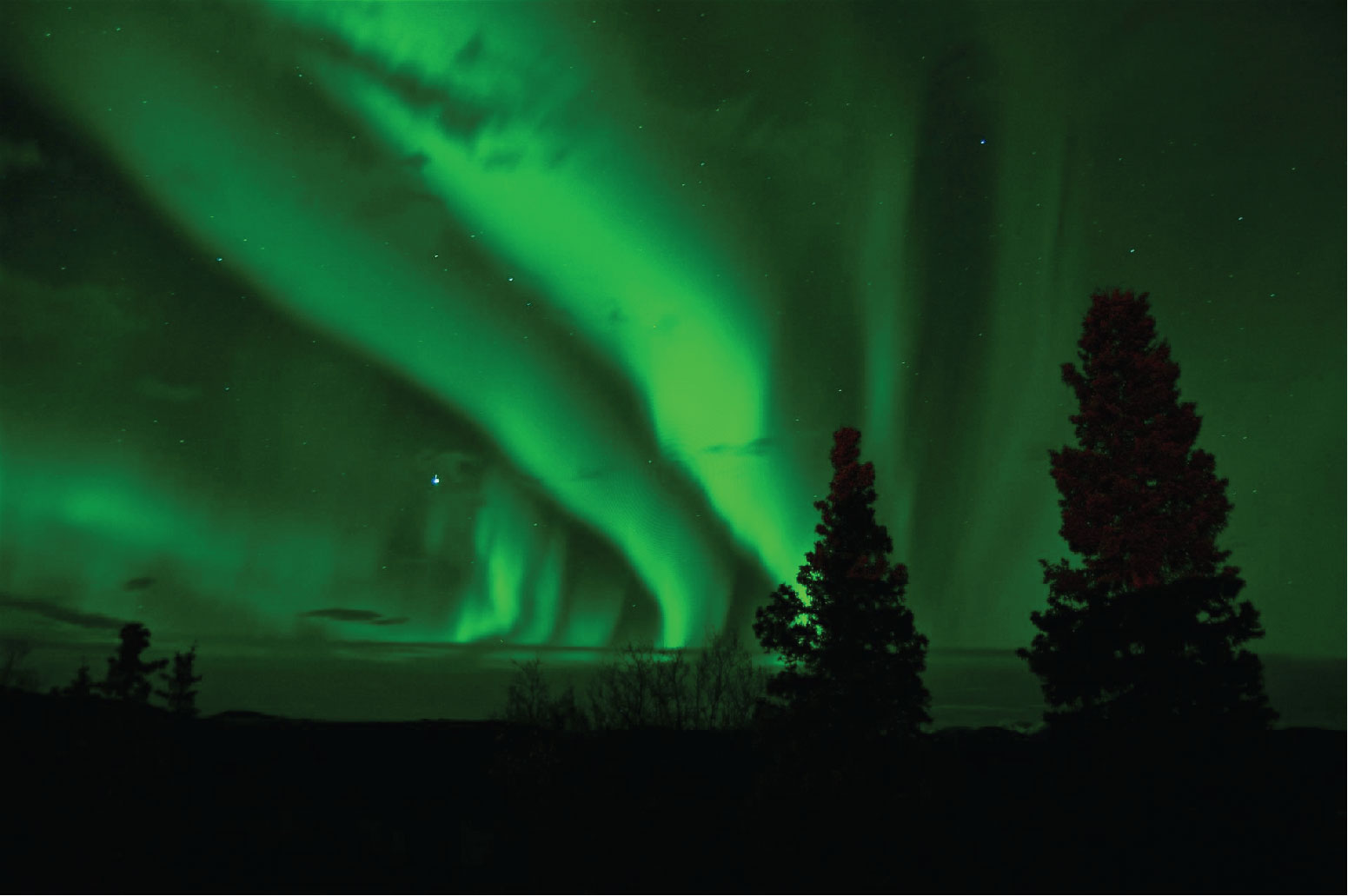
When the Sun gets rowdy Earth’s sky lights up with beautiful dancing lights. Around the poles, colorful auroral streams dance and flicker across the sky. Closer to the equator, though, a different empyrean glow appears: the blushing, mauve-pink STEVE, and its attendant green-striped picket fence.
The nature of the atmospheric lights known as STEVE (Strong Thermal Emission Velocity Enhancement) and the picket fence has long puzzled scientists. Initially considered akin to auroras, recent research challenges this assumption, proposing a groundbreaking idea. According to physicist Claire Gasque and her team from the University of California Berkeley, these phenomena are not auroras at all.
In contrast to auroras, which are thought to be driven by magnetic fields, Gasque’s team suggests that STEVE and the picket fence result from electric fields aligned parallel to magnetic field lines. What makes this proposition significant is that these lights occur at lower latitudes than traditional auroras. If proven accurate, this theory could reshape our understanding of Earth’s atmosphere, magnetosphere, and their intricate interactions, revolutionizing our grasp of atmospheric physics. the Sun gets rowdy
Physicist Brian Harding from UC Berkeley notes, “We’ve known for a couple of years now that the STEVE spectrum is telling us there’s some very exotic physics going on. We just didn’t know what it was.” Gasque’s research, outlined in her paper, indicates that parallel electric fields may provide the explanation for the enigmatic spectrum associated with STEVE.