

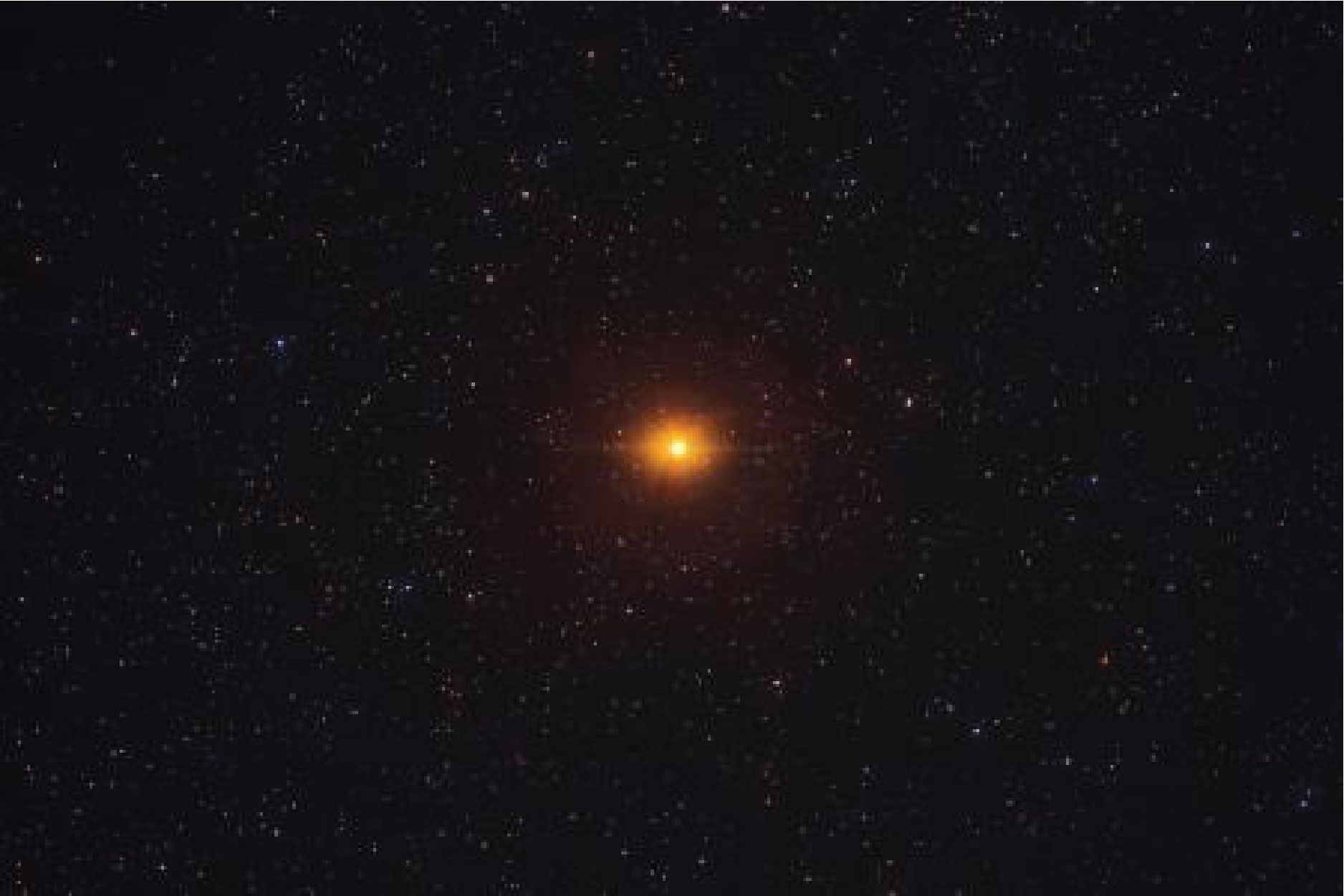
In a captivating celestial event, one of the night sky’s most prominent stars is poised to temporarily disappear as it undergoes a unique eclipse caused by the passage of an asteroid.
This rare and transient phenomenon, set to occur late Monday into early Tuesday, is expected to be observable by millions along a narrow path extending from central Asia’s Tajikistan and Armenia, crossing through Turkey, Greece, Italy, and Spain, before reaching Miami and the Florida Keys, and finally, parts of Mexico.
The star at the center of this cosmic spectacle is Betelgeuse, a red supergiant situated in the Orion constellation. The asteroid responsible for this celestial dance is Leona, an elongated space rock in the primary asteroid belt between Mars and Jupiter, known for its slow rotation. The event promises a celestial display that captures the imagination of sky gazers around the world. a captivating celestial
Astronomers are eager to glean additional insights into both Betelgeuse and Leona as they prepare to witness the upcoming eclipse, projected to be a brief event lasting no more than 15 seconds. In a prior observation, a Spanish-led team seized the opportunity to study an eclipse of a fainter star by Leona in September. Through this observation, they estimated the dimensions of the asteroid to be approximately 34 miles wide and 50 miles long (55 kilometers wide and 80 kilometers long). This upcoming celestial occurrence presents a valuable opportunity for scientists to expand their understanding of these celestial bodies and deepen their knowledge of the cosmic phenomena taking place in our universe.
There are lingering uncertainties over those predictions as well as the size of the star and its expansive atmosphere. It’s unclear if the asteroid will obscure the entire star, producing a total eclipse. Rather, the result could be a “ring of fire” eclipse with a miniscule blazing border around the star. If it’s a total eclipse, astronomers aren’t sure how many seconds the star will disappear completely, perhaps up to 10 seconds.