

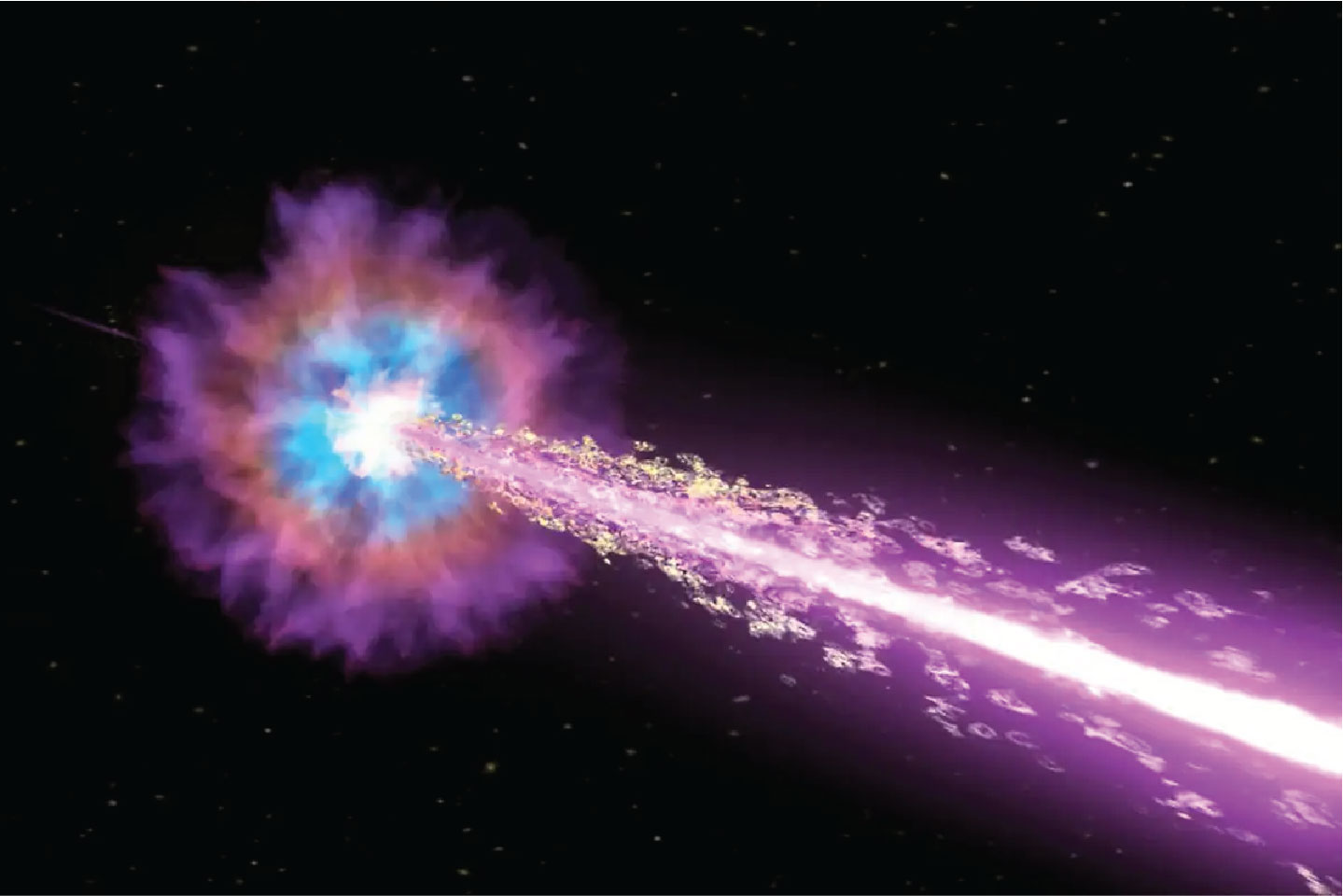
Recent research indicates that various types of neutron stars, formed when massive stars reach the end of their life cycles, exhibit similar behavior. While this might initially seem like a modest discovery, it carries significant implications. The findings provide additional support for the hypothesis that these incredibly dense dead stars, with a density equivalent to a tablespoon weighing as much as Mount Everest, could be linked to enigmatic phenomena known as Fast Radio Bursts (FRBs).
Millisecond-long bursts of radio emission FRBs seem to come from sources beyond the limits of the Milky Way, yet since their discovery in 2007, their origins have remained shrouded in mystery. There is one possible suspect, however: Highly magnetic neutron stars, or magnetars. Recent research indicates
The recent discovery, led by a team including researchers from the Max Planck Institute for Radio Astronomy (MPIfR) and the University of Manchester, reveals that magnetars exhibit a connection between pulse structure and rotation similar to that observed in other “radio-loud” neutron stars. This commonality among different types of neutron stars strengthens the understanding of their behavior and potentially reinforces the association with phenomena like Fast Radio Bursts (FRBs).
The discovery of a similar “universal scaling” between different sorts of neutron stars hints at the plasma processes that may be responsible for these radio emissions themselves; it also leads scientists to interpret structures seen in FRBs as being the result of a corresponding rotational period, the team says.