

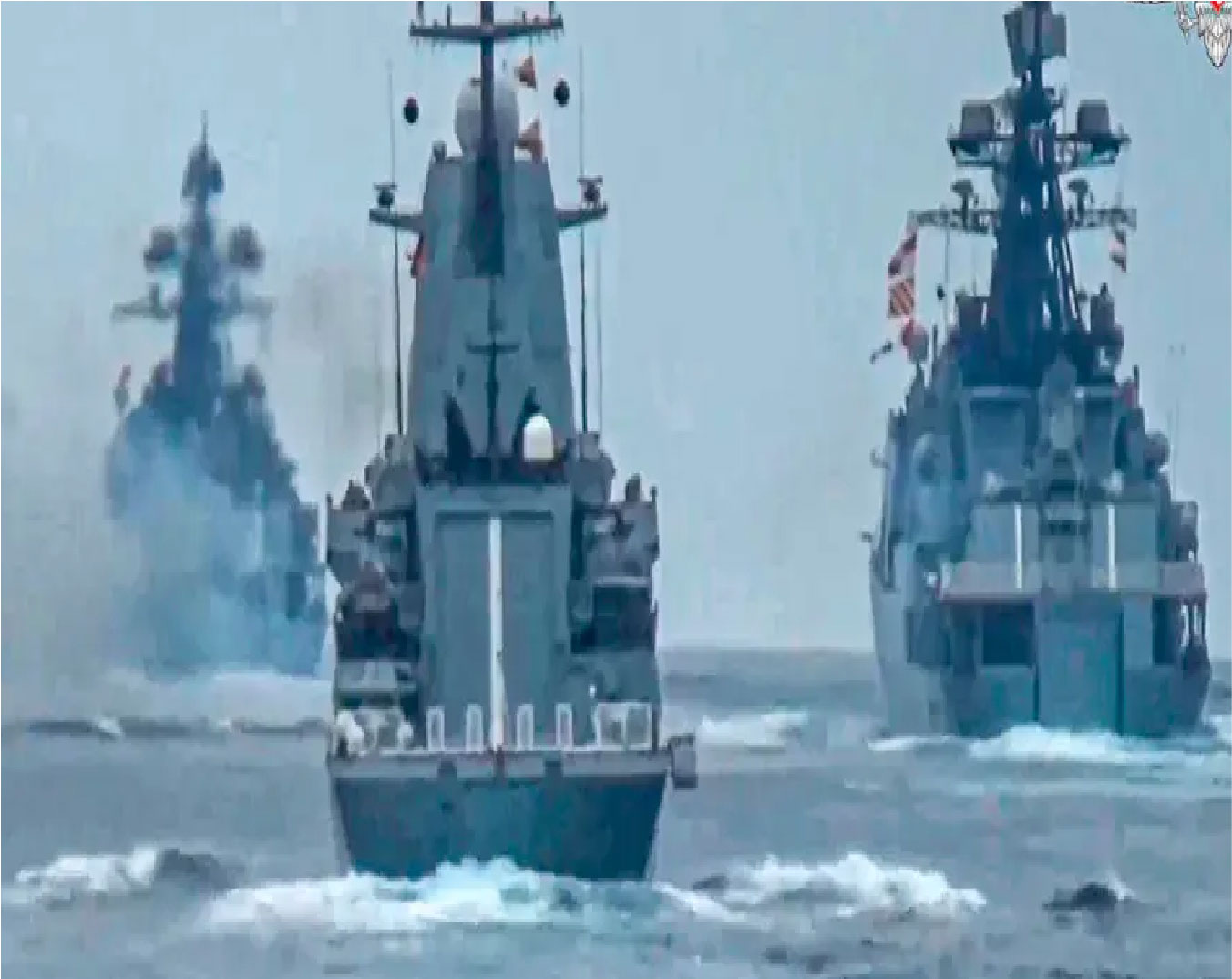
Despite lacking its own navy, Ukraine has executed a series of successful attack. So including strikes on Russia‘s Black Sea navy HQ in Sevastopol in September. And its 612ft flagship Moskva last April. Sky News has uncovered that Russia has recently repainted five of its fleet’s ships. And including the flagship Admiral Makarov, over the past two months. Analysts believe this move aimed at safeguarding the “vulnerable” fleet. Russia’s Black Sea navy
The Black Sea Fleet (BSF), comprising approximately 30 warships, primarily stationed in Sevastopol, in the occupied territory of Crimea. Between May 26 and July 4 of this year. The bow and stern of five warships. Including the Admiral Makarov (which became the flagship after the Moskva’s sinking).were painted navy blue or black.
Experts suggest that this repainting of ships like Makarov. Its sister ship Admiral Essen, Ivan Gobulets, Muromets, and Grayvoron serves a twofold purpose: to visually confuse Ukrainian threats. So including sea drones, and to create an illusion of smaller vessels. Ukraine has known to employ sea drones in its attacks, unmanned vessels carrying explosives that travel on the water’s surface.
Comparison of archive images of the five ships with recent pictures posted on a Russian Telegram channel linked to KCHF.The fleet’s website, reveals these changes. While the exact date of repainting couldn’t verified, the timeline base on the dates the images were posted online.
Open-source researchers previously noted that the painted Admiral Essen could also seen in satellite imagery. And the ship equipped with an 8 Kalibr land missile.So regularly used against Ukraine in the conflict. This technique of painting ships is akin to a “new form of dazzle painting.” A decoy tactic employing irregular patterns and colors. Initially developed during World War I to protect vessels from German boats at sea. Analysts point out that painting both sides of the boat is an attempt to make it appear smaller and obscure key features like helipads.
While naval decoy tactics are not novel, they indicate the threat posed by Ukraine. Defense and security analyst Professor Michael Clarke remarks that this tactic. And though cost-effective, reflects Russia’s unanticipated vulnerability in the Black Sea Fleet due to Ukrainian pressure. It offers Russian forces extra time to intercept incoming missiles if drones deceived the visual distraction, although its effectiveness diminishing.
Ukraine possesses drones that rely on radar signature and infrared signals for detection, making a coat of paint ineffective in some cases. Nonetheless, Russia hasn’t limited this decoy technique to naval camouflage; it has also employed it to safeguard its airbases, even those near Moscow.
Satellite imagery, previously highlighted by open-source researchers, reveals that Russia has painted several aircraft on the tarmac at airbases to deceive Ukrainian drones. Images from Engels and Yeysk airbases and an S400 missile launcher base over the past few months show aircraft, including Tu-95 strategic bombers, painted onto the runways. The S400 base near Moscow further underscores the proximity of the conflict to Russia’s heartland.
Raphael S. Cohen, Director of Strategy & Doctrine Program at Project Air Force, RAND, notes that this indicates the war is getting closer to Russia’s doorstep. The fact that Russia is taking steps to camouflage its bases suggests that Ukraine has disrupted Russian base defenses and thrown them off balance.
Satellite images have also revealed the placement of tires on top of aircraft at Engels airbase, believed to be a measure to prevent damage from nearby explosions.
President Biden authorizes construction of border barrier with Mexico.