

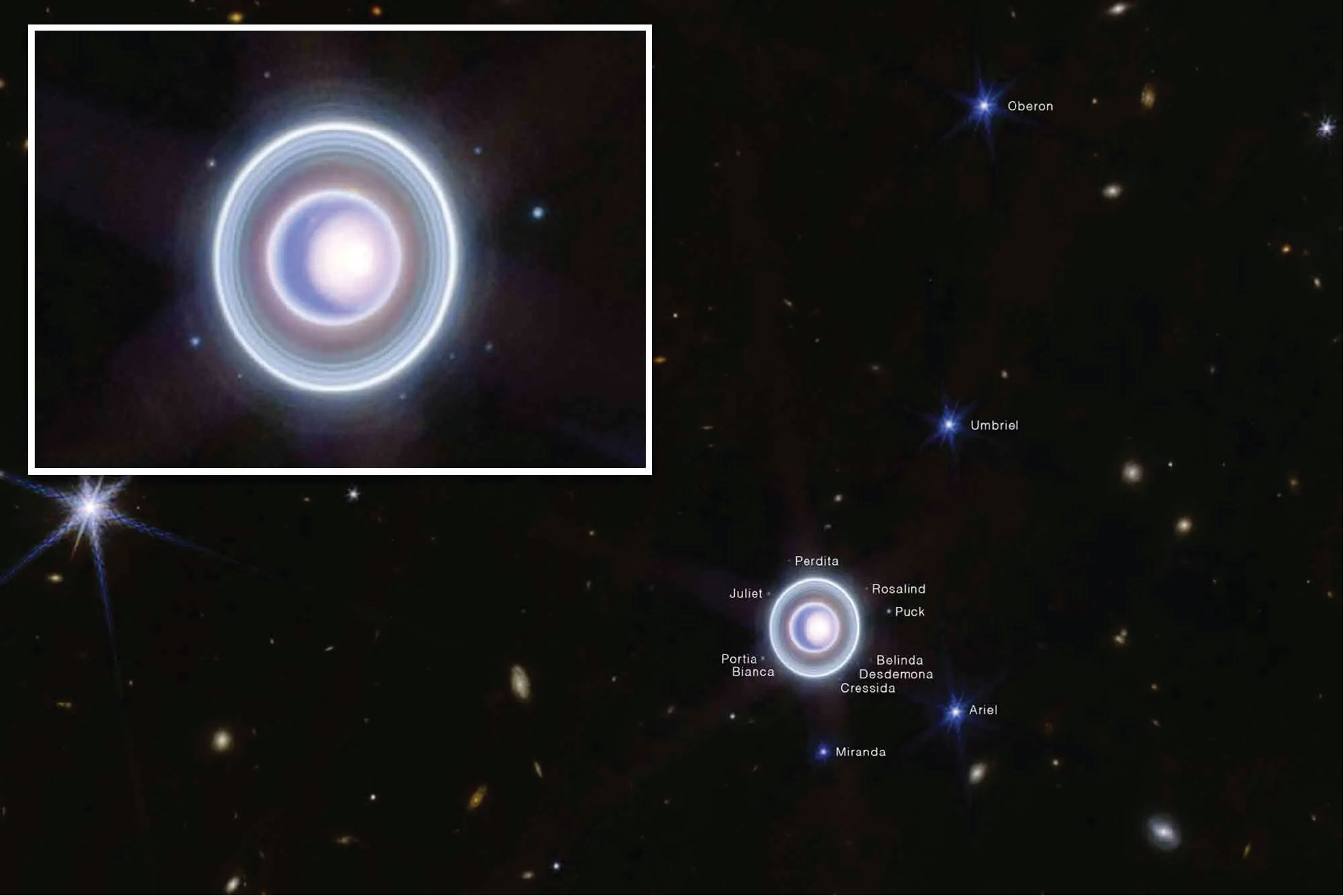
NASA released new images Monday that show Uranus, the seventh planet from the sun, in greater detail than ever before.
The new images of Uranus were captured by the James Webb Space Telescope and build on the photos released earlier this year, adding “additional wavelength coverage for a more detailed look” at the planet.
The James Webb Space Telescope has provided unprecedented clarity in observing Uranus and its distinctive features, according to NASA. The infrared resolution and sensitivity of Webb’s instruments allow astronomers to gain groundbreaking insights into Uranus, including close-up views of the Zeta ring. NASA emphasized the value of these detailed observations for planning potential future missions to Uranus.
The imagery captured by Webb showcases the planet’s rings, moons, storms, and atmospheric features, offering an enhanced understanding of Uranus. The telescope’s advanced capabilities allowed it to photograph many of Uranus’s 27 known moons, as well as the dim inner and outer rings, providing valuable data for planetary scientists. the seventh planet
The recently released images from the James Webb Space Telescope not only provide enhanced clarity but also offer a new perspective on the appearance of Uranus. In the 1980s, Voyager 2 captured visible-wavelength images depicting the planet as a “placid, solid blue ball.” Now, with Webb’s infrared capabilities, the images reveal Uranus as a “strange and dynamic ice world” with exciting atmospheric features.
The planet’s unique axial tilt, causing it to spin on its side, results in an unusual seasonal polar cap, showcased in greater detail in the new images. Notable features include the bright, white inner cap and a dark lane in the bottom of the polar cap toward lower latitudes, which are more discernible in the newer images. The observations by the James Webb Space Telescope contribute to a deeper understanding of Uranus’s atmospheric dynamics.