

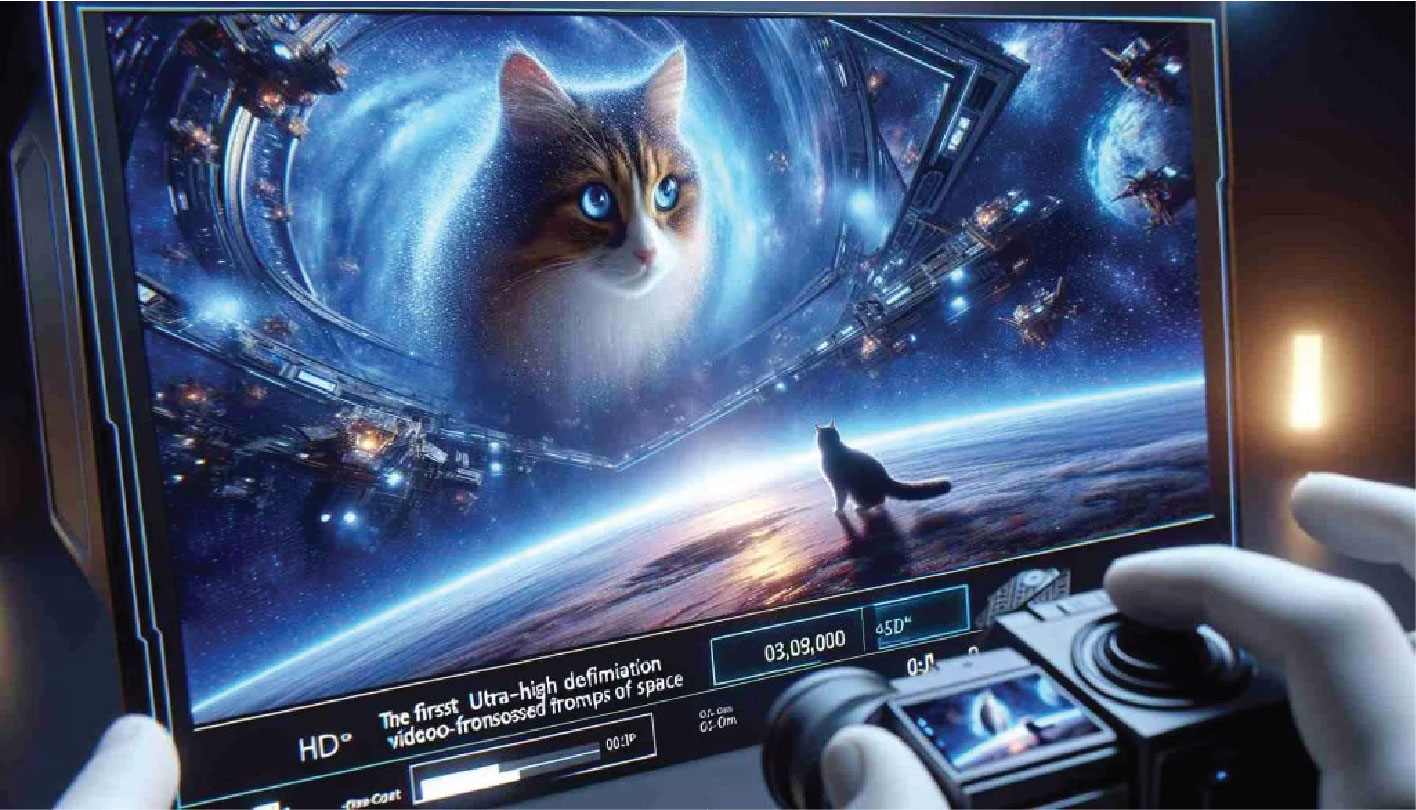
A laser communications experiment conducted on NASA’s Psyche mission has successfully transmitted a video to Earth from a distance of nearly 19 million miles (31 million kilometers). Notably, the brief clip features a cat named Taters. This achievement marks the inaugural instance of NASA employing laser technology to stream video content from deep space.
In the ultra-high definition video, the playful orange tabby cat chases, of all things, the elusive red dot from a laser pointer as it moves across a couch.
The transmission of the cat video occurred through a flight laser transceiver as an integral component of the Deep Space Optical Communications experiment, abbreviated as DSOC.
This innovative technology holds the potential for future applications, allowing the rapid transmission of data, imagery, and videos. As humanity continues to expand the horizons of space exploration, with endeavors such as missions to Mars, DSOC could play a pivotal role in enhancing communication capabilities in deep space. A laser communications
Encoded in a near-infrared laser, the 15-second video was transmitted from the Psyche spacecraft to the Hale Telescope at the California Institute of Technology’s Palomar Observatory. The download of the video took place at the observatory on December 11, with each frame being streamed in real-time at NASA’s Jet Propulsion Laboratory, located in Pasadena, California. This groundbreaking use of laser technology showcases the potential for advanced communication methods in space exploration.
At the time of the transmission, the distance between the Psyche spacecraft and Hale was 80 times the distance between Earth and the moon. It only took 101 seconds for the laser to each Earth.
The laser can send data at 10 to 100 times the speed of traditional radio wave systems NASA uses on other missions. The tech demo was designed to be NASA’s most distant experiment of high-bandwidth laser communications, testing the sending and receiving of data to and from Earth using an invisible near-infrared laser.
“This accomplishment underscores our commitment to advancing optical communications as a key element to meeting our future data transmission needs,” NASA Deputy Administrator Pam Melroy said in a statement. “Increasing our bandwidth is essential to achieving our future exploration and science goals, and we look forward to the continued advancement of this technology and the transformation of how we communicate during future interplanetary missions.”