

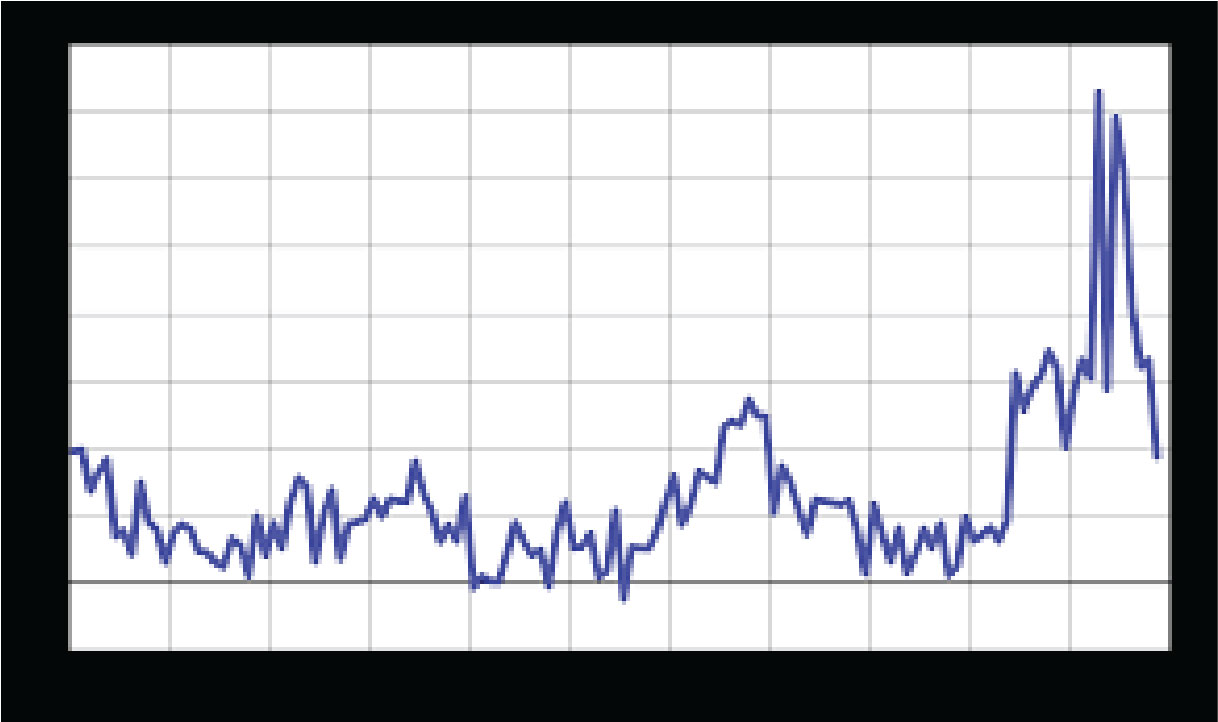
Despite international sanctions the Russian economy has rebounded to almost prewar levels earlier this year, as per the latest data from the Federal State Statistics Service. Western news outlets and analysts now acknowledge this recovery. Vladimir Putin proudly asserts Russia’s resilience, stating it is more than just a “gas station,” while presidential economic adviser Maxim Oreshkin argues that Europe has borne a heavier brunt from sanctions than Russia itself. However, amid the apparent economic recovery, there are concerns; millions of Russians are feeling the impact of the surge in military production as inflation rises to 7.5 percent. With signs of an overheating economy, there are predictions of a slowdown or even a recession in 2024.
Following the February 2022 invasion of Ukraine and the subsequent Western sanctions, Russia experienced a recession, but recent data from the Center for Macroeconomic Analysis and Short-Term Forecasting (TsMAKP) indicates a rebound. The recession reportedly ended in August after a brief 10 months. While acknowledging the potential bias of TsMAKP, given its director’s connection to the government, Russia’s gross domestic product (GDP) recorded a 5.5 percent growth in the third quarter of 2023 and a 3.2 percent increase in the first 10 months of the year. Notably, the GDP for 2023 is 1.1 percent higher than the same period in 2021, predating the invasion of Ukraine and subsequent sanctions. Despite international sanctions
Russia has surpassed the predictions of its own Economic Development Ministry and Central Bank, which initially forecasted a year-on-year GDP growth of no more than 2 percent. Bloomberg Economics analysts now suggest that the growth in 2023 could exceed 3 percent. President Vladimir Putin, emphasizing the significance of the economic indicators, proudly declared that Russia’s annual GDP growth will surpass 3.5 percent. He asserted that only 2 percent of the country’s growth stemmed from resource extraction.
Despite these positive economic indicators, some analysts caution that the spike in economic output may be a recovery from a slump, similar to the rebound observed in 2021 after the COVID-19 pandemic. This suggests that Russia’s surging GDP may not necessarily reflect sustainable development, contrary to Putin’s assertions.