

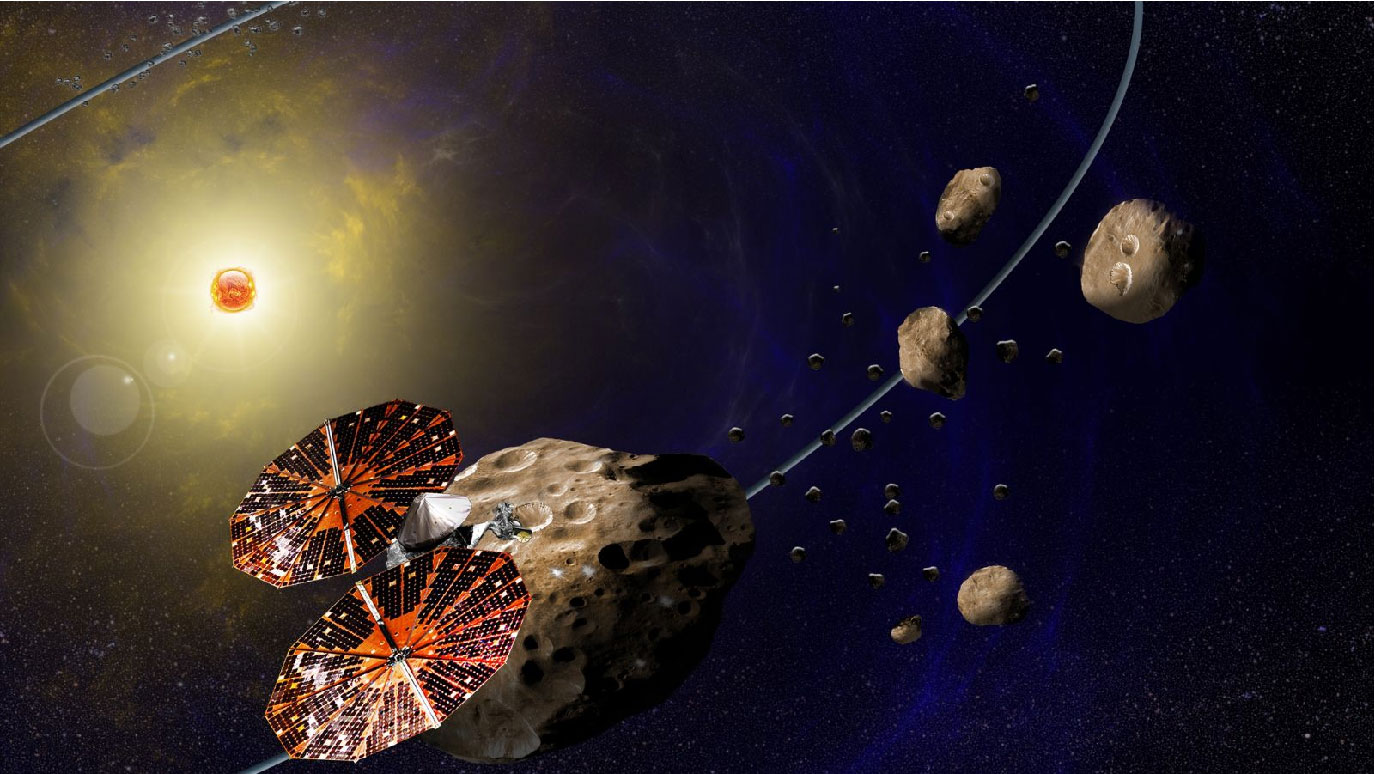
NASA’s Lucy mission, which recently conducted a flyby of the small asteroid Dinkinesh in the solar system’s main asteroid belt, uncovered a surprise. What was initially believed to be a single asteroid turned out to be a binary pair of space rocks.
Hal Levison, the principal investigator for the Lucy mission at the Southwest Research Institute, expressed his enthusiasm, stating that Dinkinesh, which means “marvelous” in the Amharic language of Ethiopia, truly lived up to its name. He added, “When Lucy was originally selected for flight, we planned to fly by seven asteroids. With the addition of Dinkinesh, two Trojan moons, and now this satellite, we’ve turned it up to 11.”
Astronomers had their first indications that Dinkinesh might be a binary pair when Lucy’s instruments detected changes in brightness in the weeks leading up to the spacecraft’s close approach to the asteroid.
During its closest approach to the asteroid Dinkinesh, the Lucy spacecraft came within 265 miles (425 kilometers) of the asteroid’s surface on Wednesday afternoon. the small asteroid Dinkinesh
The close approach served as a test for the Lucy spacecraft’s suite of equipment, including its terminal tracking system, which enables the spacecraft to autonomously locate the space rock and maintain its view while passing at a speed of 10,000 miles per hour (4.5 kilometers per second). Tom Kennedy, a guidance and navigation engineer at Lockheed Martin (a NASA partner on the Lucy mission), expressed satisfaction with the results, noting that the terminal tracking system worked as intended, even when facing a more challenging target than expected.