

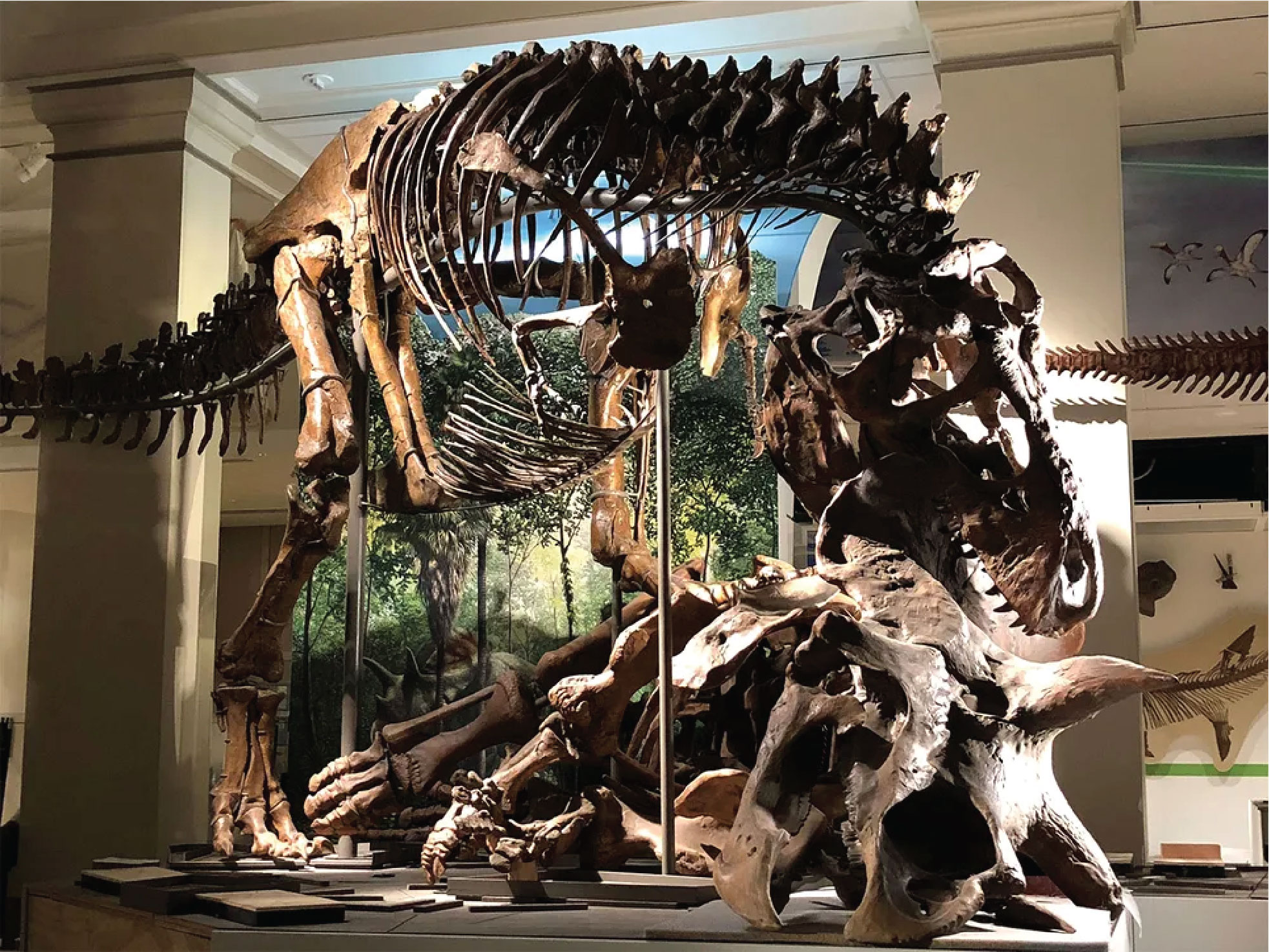
The Tyrannosaurus rex seemingly came out of nowhere tens of millions of years ago, with its monstrous teeth and powerful jaws dominating the end of the age of the dinosaurs.
The enigmatic origins of certain paleontological mysteries have perplexed scientists for years. A collaborative effort by researchers from various universities and the New Mexico Museum of Natural History and Science has recently added a significant piece to the puzzle.
In their unveiling on Thursday, the team presented fossil evidence and shared their discoveries in the journal Scientific Reports. The study introduces a newly identified subspecies of tyrannosaur, believed to be an older and more primitive relative of the well-known Tyrannosaurus rex.
As the massive jawbone and distinctive pointed teeth were revealed, eliciting gasps and excitement, a group of schoolchildren witnessed the unveiling. Fragments of this delicate specimen were initially discovered in the 1980s by boaters along the shores of New Mexico’s largest reservoir.
The identification of the new tyrannosaur subspecies resulted from a meticulous reassessment of the jaw and other skull fragments collected over years at the excavation site. The research team conducted a thorough analysis of each bone in the specimen, carefully noting variations in numerous features that distinguish it from the well-known Tyrannosaurus rex.
“Science is a process. With each new discovery, it forces us to go back and test and challenge what we thought we knew, and that’s the core story of this project,” explained Anthony Fiorillo, the executive director of the museum and a co-author of the study.
While the differences between T. rex and the newly identified subspecies, Tyrannosaurus mcraeensis, are subtle, this is commonly observed in closely related species, according to Nick Longrich, a co-author from the Milner Centre for Evolution at the University of Bath in the United Kingdom. “Evolution slowly causes mutations to build up over millions of years, causing species to look subtly different over time,” he noted.
The findings, detailed in the journal Scientific Reports on Thursday, suggest that Tyrannosaurus mcraeensis represents a side-branch in the evolutionary history of tyrannosaurs, rather than a direct ancestor of T. rex. The analysis also indicates that this new subspecies predates T. rex by up to 7 million years, challenging previous assumptions about the timeline of tyrannosaurs in North America. It suggests that these formidable predators existed on the continent much earlier than paleontologists had previously believed.