

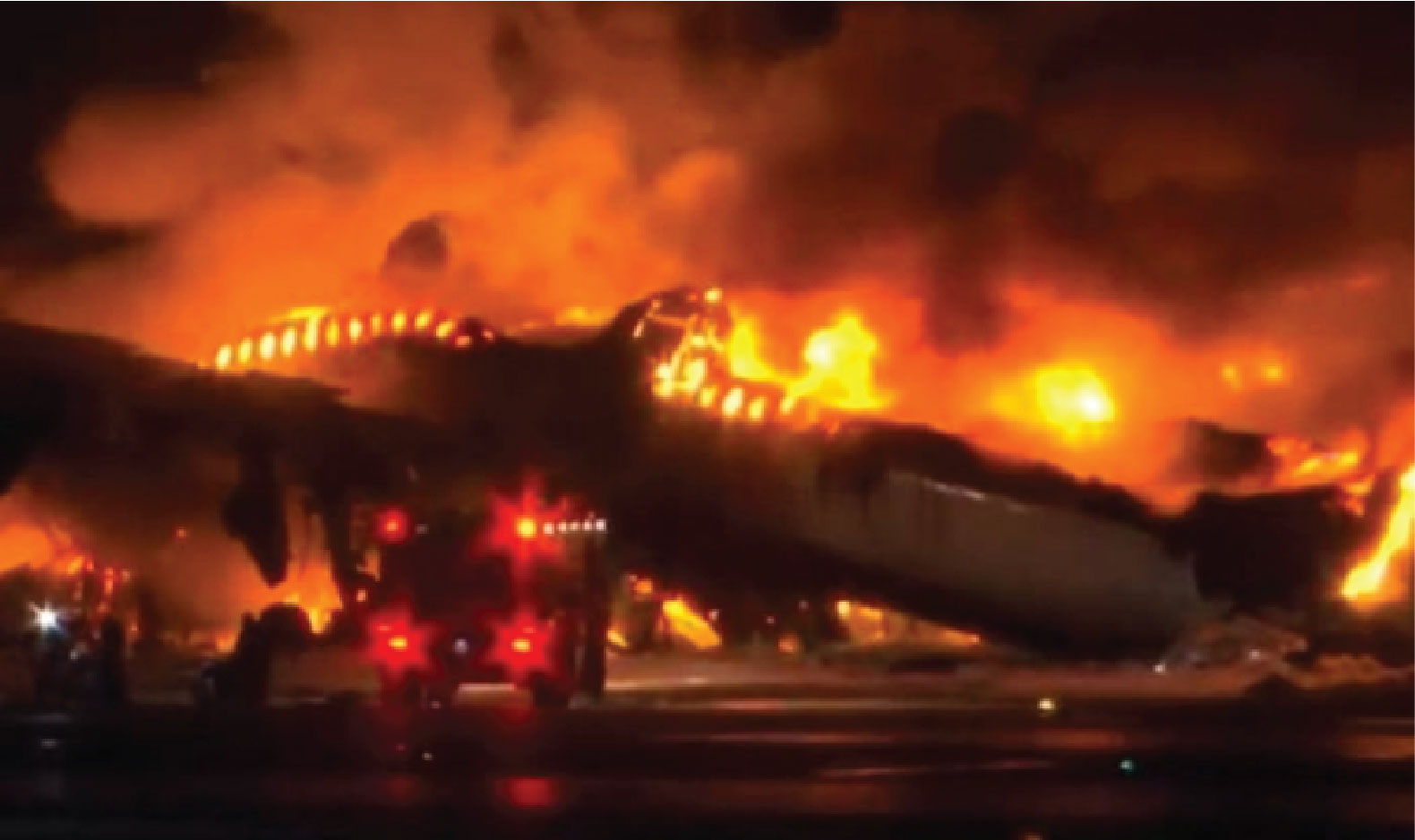
Watching the footage of the Japan Airlines collision at Tokyo Haneda airport it seems miraculous that anyone has emerged unscathed.
Yet while, tragically, five of six crew on the Japan Coast Guard Dash 8 plane it struck during landing on Tuesday have died, all 379 passengers and crew onboard the Airbus A350 have survived the accident.
As investigations continue into the recent incident where a Japan Airlines (JAL) plane caught fire, leading to a successful evacuation, experts attribute the positive outcome to a combination of contemporary safety standards and the airline’s meticulous safety culture.
Graham Braithwaite, a professor of safety and accident investigation at Cranfield University in the UK, expressed surprise and relief at the successful evacuation, noting the severity of the impact. He emphasized that JAL’s commitment to safety and crew training played a pivotal role in the favorable outcome. Tokyo Haneda airport
Interestingly, Braithwaite highlighted a pivotal moment almost four decades ago that contributed to Japan Airlines’ reputation for safety. In 1985, JAL Flight 123 from Tokyo to Osaka crashed, resulting in 520 casualties out of 524 onboard. The tragedy, caused by a faulty repair of the tail by Boeing technicians (not the airline’s), remains the deadliest single-aircraft accident in aviation history.
According to Braithwaite, the profound impact of this incident prompted Japan Airlines to adopt a collective responsibility mindset, vowing to prevent a recurrence. He explained that in Japanese culture, challenges are viewed as opportunities to learn and improve, and the airline has since maintained a strong focus on continuous enhancement.
The recent incident at Haneda International Airport, where a JAL A350 caught fire, underscores the airline’s ongoing commitment to safety and its ability to draw lessons from past tragedies to ensure passenger well-being.