

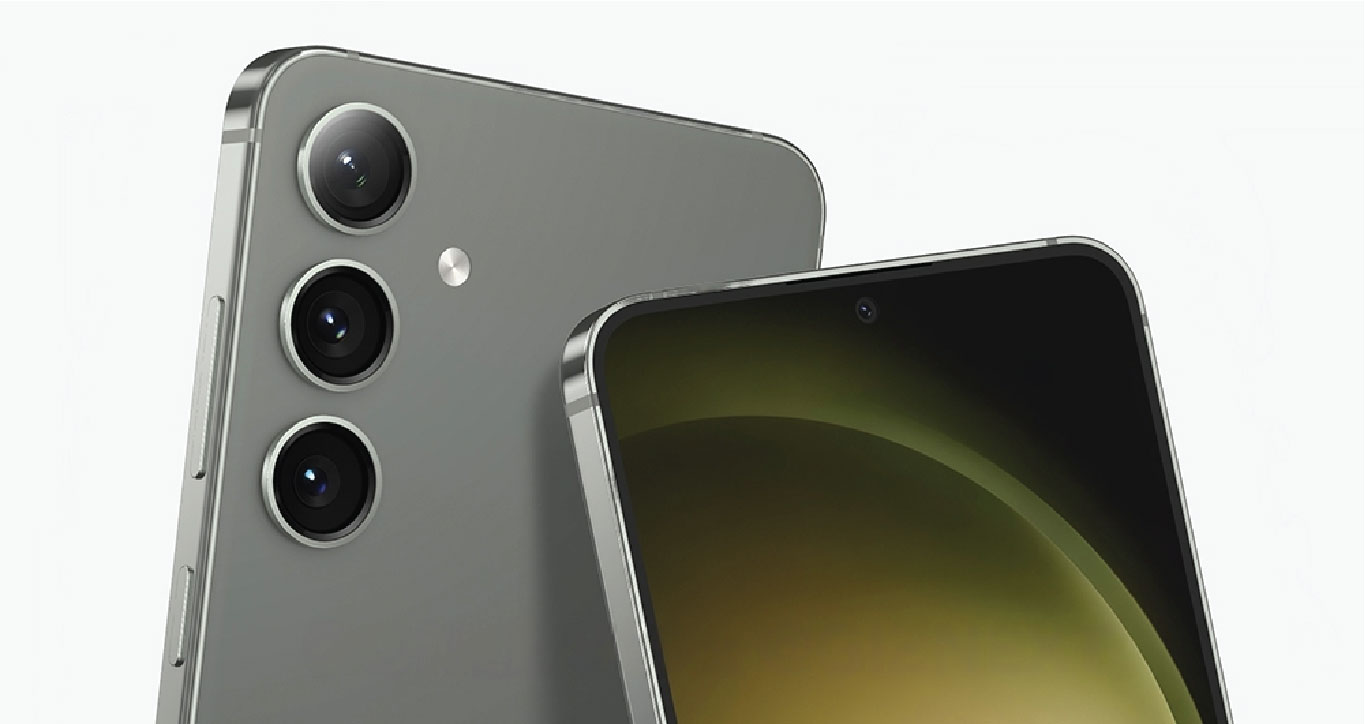
While the Galaxy S24 Ultra has been in the spotlight, the standard Galaxy S24 has received less attention. Recent leaks of the base model flagship reveal minimal changes compared to the S23 from earlier this year, particularly in its four primary color options.
The leaks surrounding the Galaxy S24 lineup have predominantly focused on the more premium S24 Ultra, known for its enhanced cameras and purportedly premium build. In contrast, the base S24 and S24+ have not generated as much anticipation.
According to earlier leaks, the Galaxy S24 won’t feature a titanium body like the S24 Ultra but will retain an aluminum frame, offering a choice of colors. The Galaxy S24 is expected to be available in “Onyx Black,” “Marble Grey,” “Cobalt Violet,” and “Amber Yellow.” the Galaxy S24 Ultra
Official-looking renders, as reported by Android Headlines, provide a detailed view of the Galaxy S24, showcasing the mentioned colors and offering a high-definition look at the device from various angles.
One of the biggest differences between the S24 and Galaxy S23 is the thickness and radius of the aluminum frame. The S23 had a thicker frame that imposed on the rear and front glass. It was also somewhat rounded. In this generation, the metal recedes a little more and gives the phone the appearance of a metal bezel. Each Galaxy S24 also carries a color-matched frame, which redeems the design a bit.
The Galaxy S24 maintains its camera design, featuring no panel surrounding each lens. The overall look of the phone, especially from the back, remains largely unchanged and can be described as basic and somewhat unremarkable.
Rumors suggest that the Galaxy S24 will have 8 GB of RAM with a starting storage capacity of 128 GB, while the S24+ may come with 12 GB of RAM. Additionally, the phones are expected to feature a 4,000 mAh and 4,900 mAh battery, respectively. The Galaxy S24+ will be equipped with the same System on Chip (SoC) as the Ultra – the Snapdragon 8 Gen 3. In contrast, the base model Galaxy S24 will be equipped with an Exynos 2400 in some European markets and a Snapdragon 8 Gen 3 in the US.