

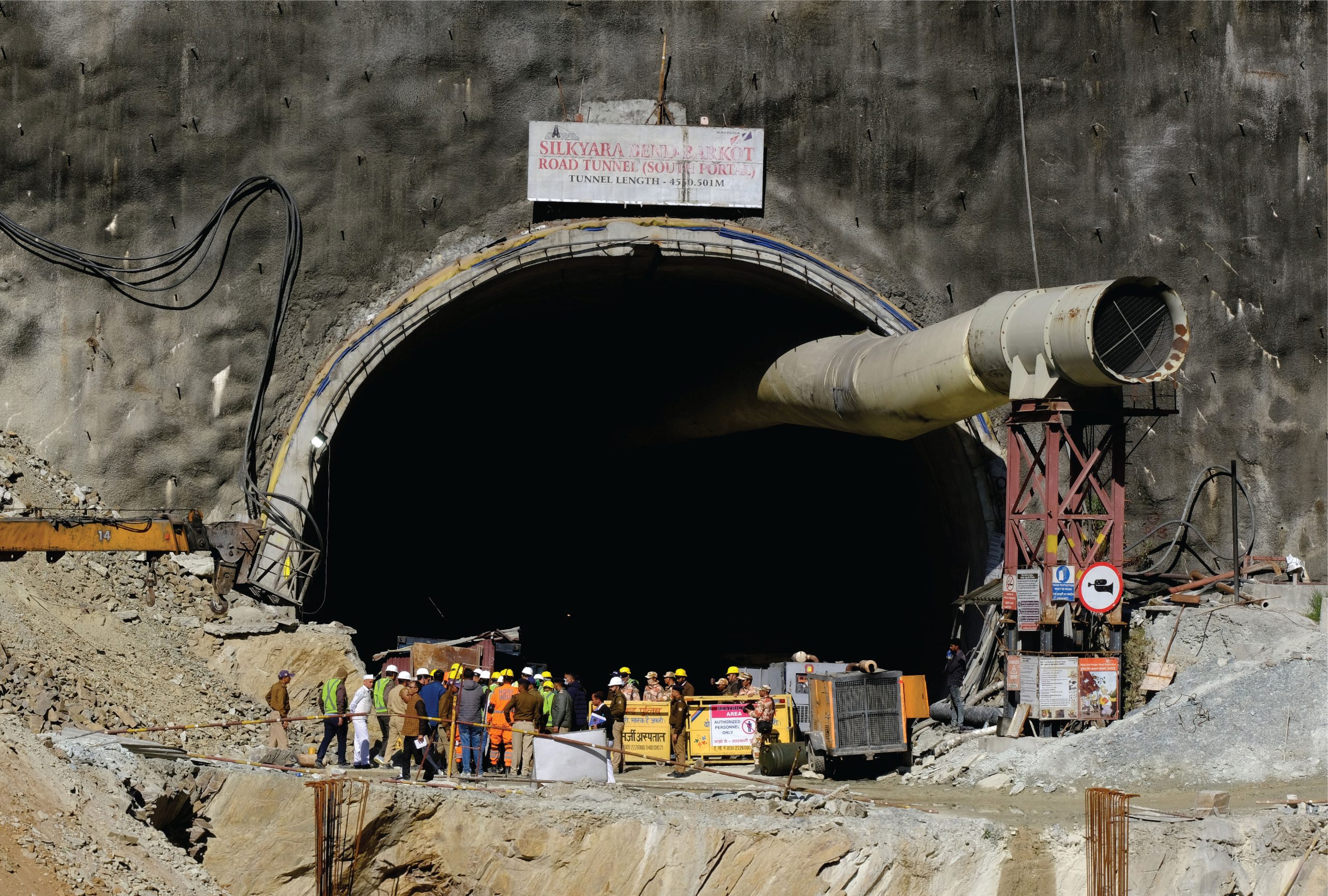
Rescuers on Tuesday successfully drilled through to 41 men trapped inside a collapsed Himalayan tunnel, as a weekslong evacuation effort fraught with uncertainty enters its final stretch.
The men have been trapped since November 12 when the part of tunnel they were helping to construct in India’s northern Uttarakhand state gave way, blocking their only exit with more than 60 meters (200 feet) of broken rock, concrete and twisted metal.
The breakthrough follows a series of agonizing setbacks, during which rescue efforts were halted when the heavy machinery used to drill through the debris broke down, forcing workers to partially dig by hand and adopt other riskier methods to bring them to safety.
Engineers faced challenges in the rescue operation as they initially attempted to excavate debris in the exit shaft using heavy machinery. Unfortunately, their efforts were hampered when the powerful US-made drill they were using broke down just meters from the trapped men, leading to the abandonment of the operation on Friday.
After 17 days, the drilling was successfully completed, according to Avinash Kumar Saini, the executive engineer for the Uttarakhand government. Simultaneously, rescuers had been drilling downward through unstable mountain terrain as a backup method to reach the trapped men, but the original plan ultimately proved successful.
Following the completion of drilling, rescuers inserted a large pipe through the final part of the exit shaft to facilitate the safe extraction of the trapped workers. Pushkar Singh Dhami, Chief Minister of Uttarakhand, expressed optimism, stating, “The work of laying pipes in the tunnel to take out the workers has been completed. Soon all the labor brothers will be taken out.”
Kirti Panwar, the state district information officer, echoed positivity, indicating that they are nearing the end of the rescue efforts. Mahi Shah, the brother-in-law of one of the trapped laborers, confirmed that rescuers have entered the tunnel, raising hope for the imminent reunion of the workers with their families.