

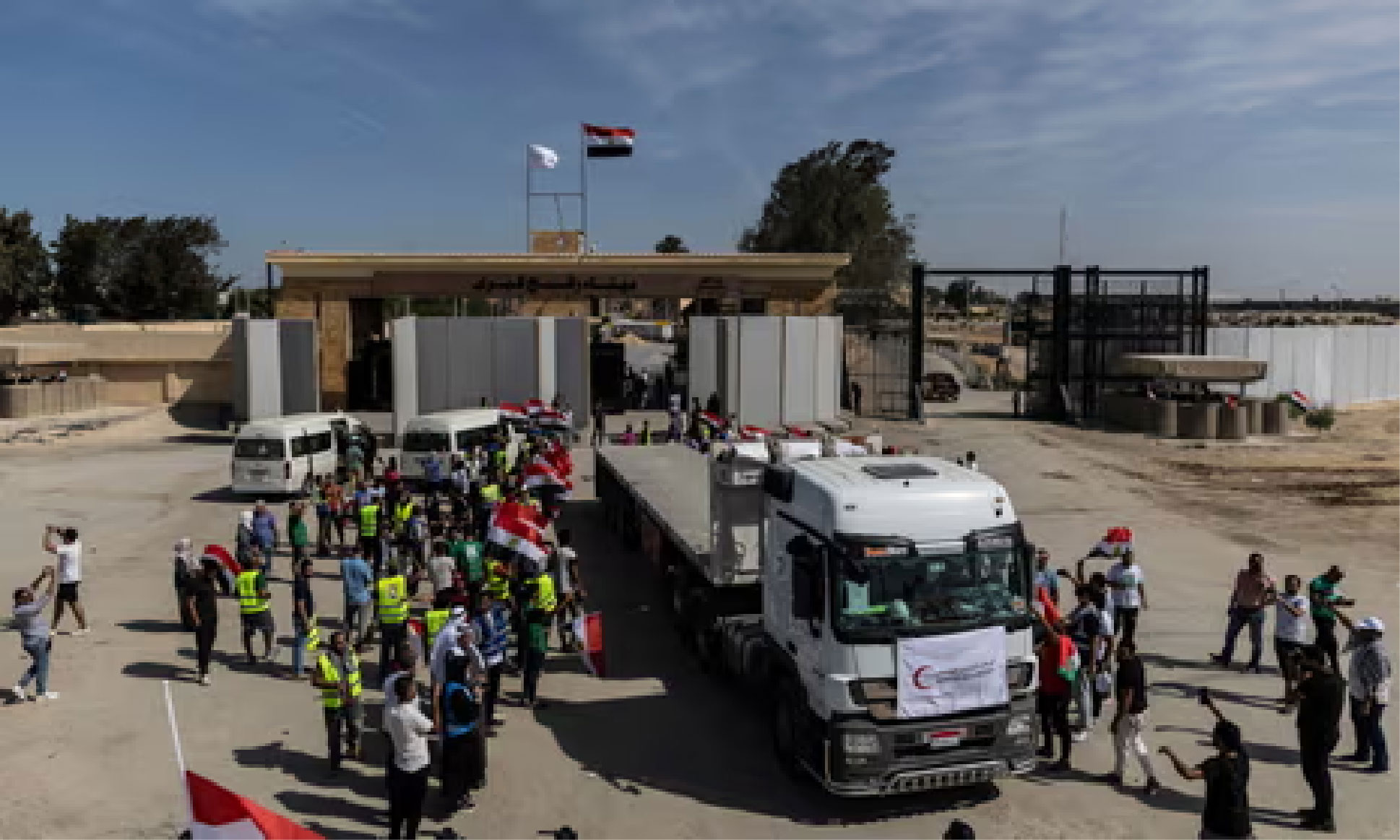
The first trucks carrying aid entered Gaza on Saturday, but international leaders have warned that much more is needed to combat the “catastrophic” humanitarian situation in the enclave that holds more than 2 million people.
These trucks were admitted two weeks after Israel imposed a complete siege on Gaza in response to deadly attacks by the militant group Hamas, which controls Gaza.
The trucks entered through the Rafah crossing, which is the only entry point to Gaza not controlled by Israel, as witnessed by CNN’s team on the Palestinian side of the border. The crossing closed soon after the 20 trucks went through.
On the Egyptian side of the border, where aid organizations had waited for days for approval, people celebrated with ululations and chants as the crossing opened. According to Egyptian authorities at the Rafah crossing, 13 trucks were carrying medicine and medical supplies, five were carrying food, and two trucks had water.
However, aid workers emphasize that while these supplies are desperately needed, they only represent a fraction of what is required for the 2.2 million people living in Gaza under a blockade imposed by Israel and Egypt.
Martin Griffiths, the United Nations under-secretary-general for humanitarian affairs and emergency relief coordinator, highlighted that the aid delivery was the result of “days of deep and intense negotiations.” He also emphasized that the humanitarian situation in Gaza has reached “catastrophic levels.”
Conditions in Gaza have deteriorated by the day, with hospitals pushed to their limits, as noted by the World Health Organization (WHO). Gazans are rapidly depleting their food, water, and essential supplies due to the near-constant bombardment by Israel. The first trucks
UNICEF reported that the convoy included more than 44,000 bottles of water, which only provides a day’s water supply for around 22,000 people. The scarcity of food is also a pressing concern, with the World Food Programme’s (WFP) executive director, Cindy McCain, revealing that starvation is widespread in Gaza.
WHO director general Tedros Adhanom Ghebreyesus emphasized that the aid provided to the people in Gaza falls significantly short of their actual needs.
The Ministry of Health in Gaza expressed that the aid convoy “constitutes only 3% of the daily health and humanitarian needs that used to enter the Gaza Strip before the aggression.” This underscores the enormous gap between the assistance delivered and the requirements of the population in Gaza.