

On Friday, the stock market experienced a decline, largely triggered by a significant increase in the 10-year Treasury yield, which raised concerns about the state of the economy.
The S&P 500 saw a 1.26% drop, closing at 4,224.16, marking its first week of losses in three weeks. The Nasdaq Composite also declined by 1.53% to finish at 12,983.81, while the Dow Jones Industrial Average lost 286.89 points (0.86%) to end the day at 33,127.28. This drop was primarily influenced by American Express, which faced pressure following a mixed earnings report.
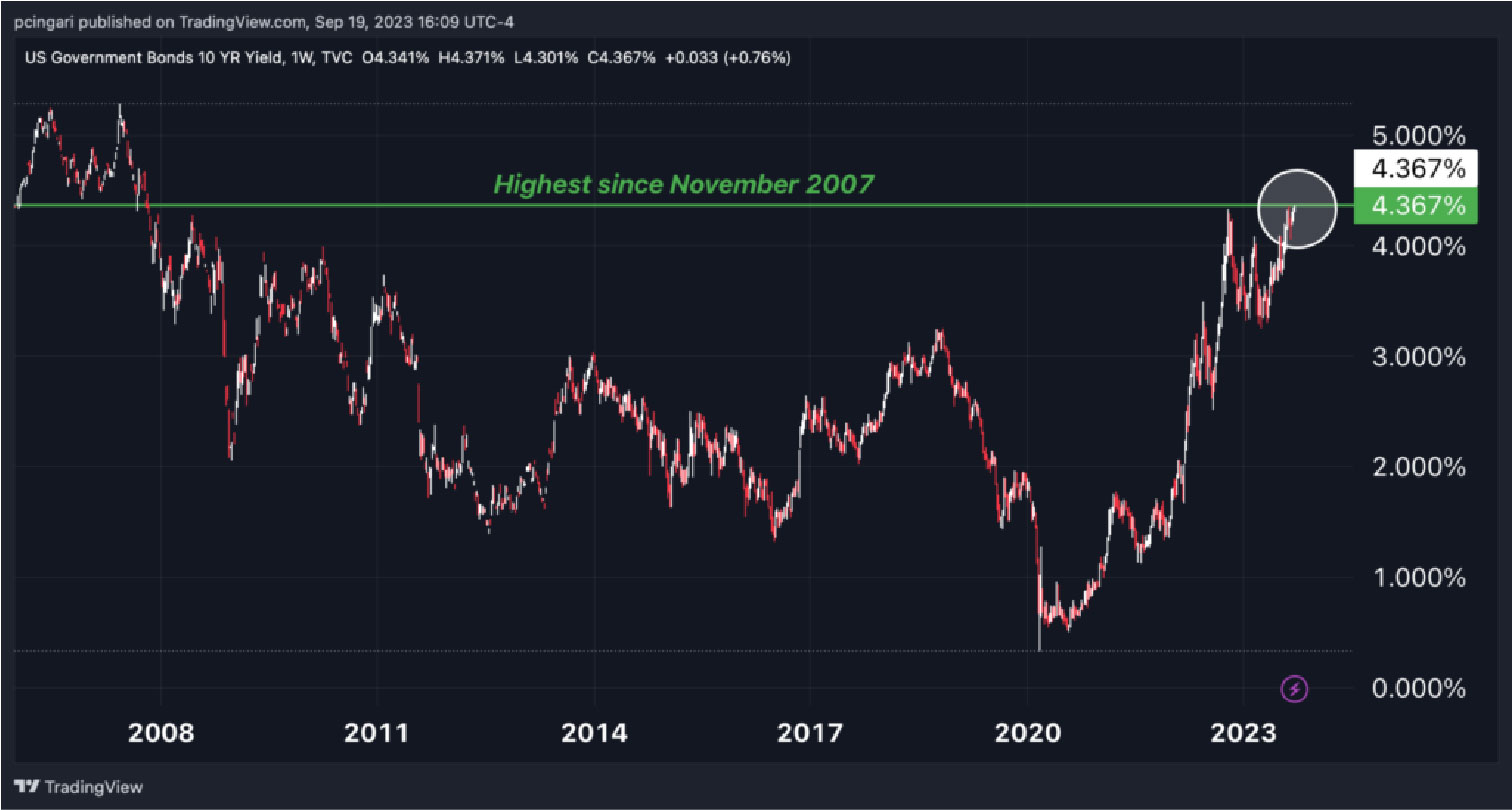
The noteworthy development was the yield on the 10-year Treasury crossing 5% for the first time in 16 years, a level that could have far-reaching effects on the economy. It has the potential to increase rates on mortgages, credit cards, auto loans, and more. Additionally, it may present an appealing alternative for investors compared to stocks.
The 10-year Treasury yield surpassed the 5% mark around 5 p.m. ET on Thursday, marking the first time it had traded above this level since July 2007. It subsequently pulled back from that level on Friday.
According to David Donabedian, the Chief Investment Officer of CIBC Private Wealth Management, “The stock market is watching the bond market and doesn’t like what it sees.” Yields are on the rise, even in the face of relatively positive news about inflation. This surge in yields is the primary reason behind the stock market’s recent weakness.
The 30-year U.S. Treasury yield also reached levels last seen in July 2007. In addition, the 30-year fixed mortgage rate reached 8% this week, a level not seen since 2000.
Concerns over rising rates had a significant impact on the market during the week. The S&P 500 experienced a 2.4% loss for the week, the Dow dipped 1.6%, and the Nasdaq shed 3.2%, marking its second consecutive week of losses.
Notable stocks that struggled during the week include Nvidia, a prominent artificial intelligence company, which had its worst week since September 2022, with losses of nearly 9%. This decline was part of a broader trend affecting semiconductor stocks following the U.S. Department of Commerce’s announcement to tighten restrictions on sales of advanced artificial intelligence chips to China.
Tesla also faced a challenging week, ending more than 15% lower, marking its worst week since December 2022. The electric vehicle manufacturer reported earnings on Wednesday, falling short of Wall Street’s expectations on both fronts for the first time since 2019. the stock market