

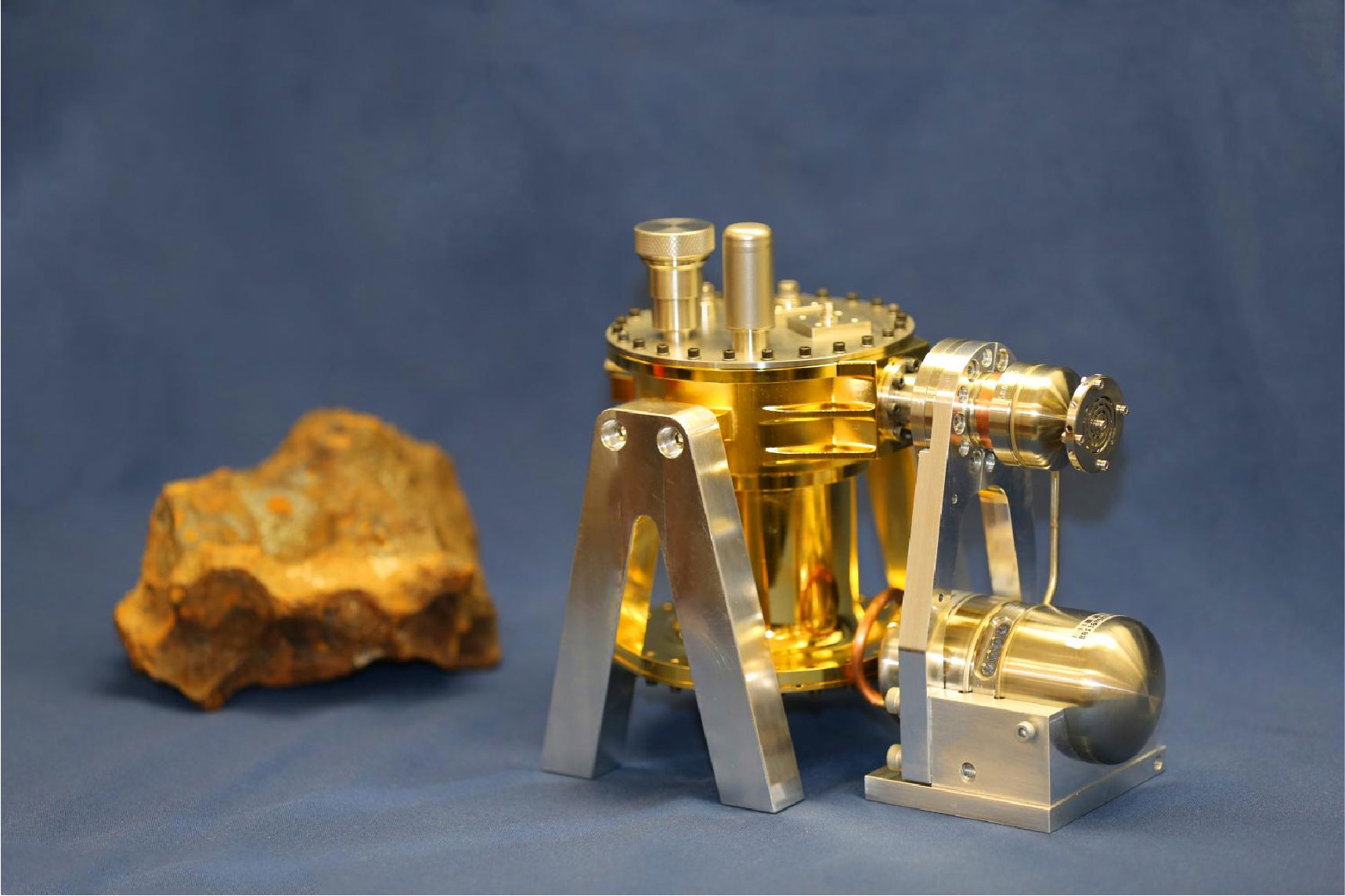
LLNL’s high-purity germanium gamma-ray sensor is a component of a suite of instruments making the journey to the largest asteroid in our solar system.
In a press release from Lawrence Livermore National Laboratory, it was announced that an instrument created and assembled by LLNL researchers has embarked on an extraordinary journey into space, covering a distance of two billion miles over the course of nearly six years. Its mission is to explore a rare, predominantly metal asteroid.
The instrument in question, the Livermore high-purity germanium (HPGe) gamma-ray sensor, plays a crucial role as part of a larger gamma-ray spectrometer (GRS), which was developed in collaboration with researchers from Johns Hopkins Applied Physics Laboratory (JHAPL) in Laurel, Maryland. This GRS, along with other instruments, will be making history by conducting the first-ever mission to Psyche, the largest metal asteroid in our solar system. The Psyche mission is under the leadership of Arizona State University (ASU).
A SpaceX Falcon Heavy rocket successfully launched, carrying NASA’s Psyche spacecraft from the Kennedy Space Center. component of a suite
Morgan Burks, a physicist from LLNL who leads the Lab team, explained the scientific significance of the Psyche mission, stating, “Psyche is scientifically interesting because it is thought to be a planetary core, a remnant of a collision during the early stages of the development of the solar system. We believe that exploration of the Psyche asteroid could increase our understanding of the hidden cores of Earth, Mars, Mercury, and Venus.” This mission to the Psyche asteroid has the potential to provide valuable insights into the origins and composition of planetary cores, shedding light on the inner workings of celestial bodies within our solar system.
Psyche mission principal investigator Lindy Elkins-Tanton of ASU noted that the exploration of Psyche will permit scientists to “literally visit a planetary core — the only way humankind ever can.”