

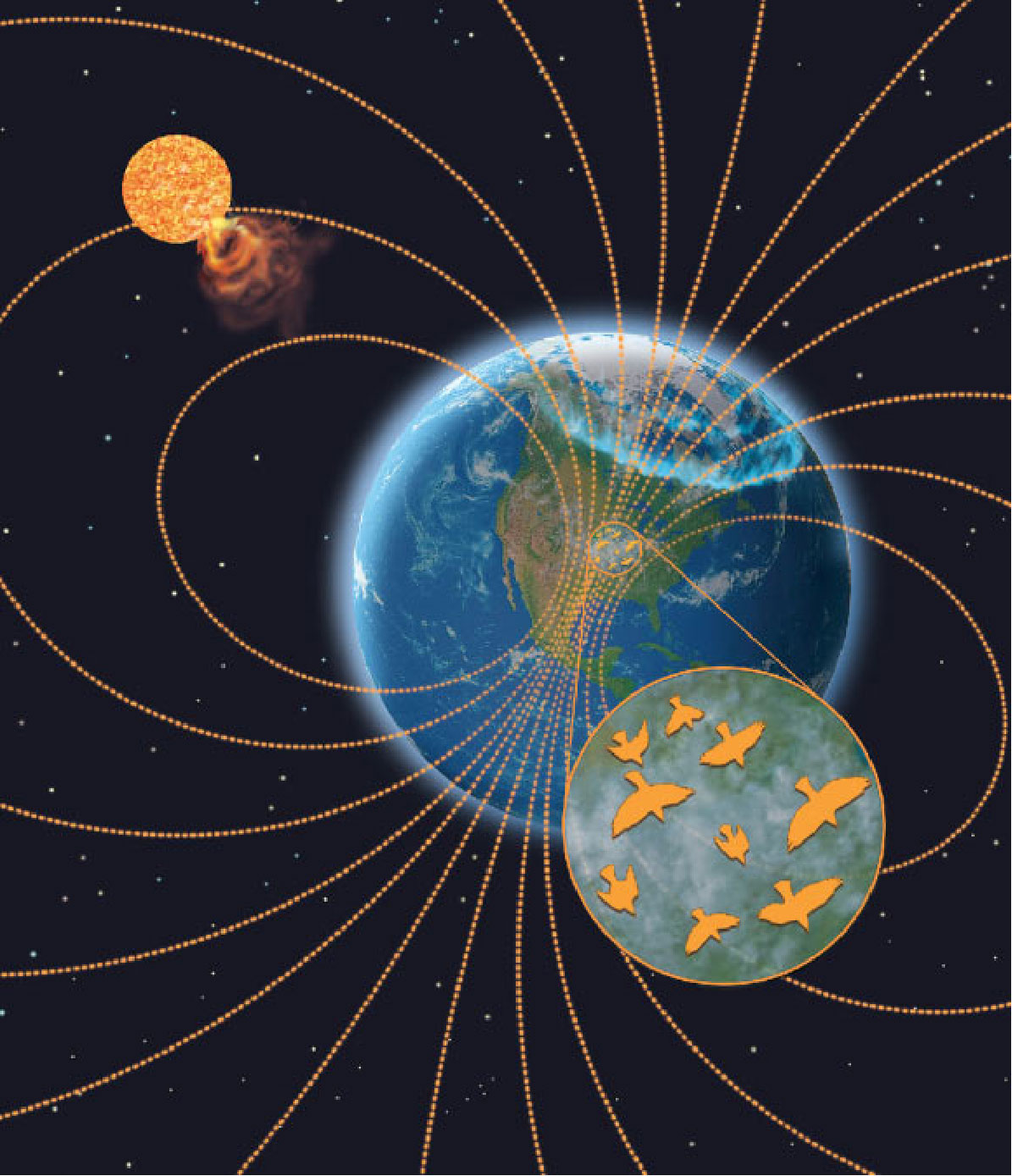
Space weather events, including solar flares and other energetic outbursts. And periodically disrupt Earth’s magnetic field, which is crucial for the navigation of migratory birds during their long-distance journeys.
New Delhi: Recent research indicates that severe space weather events link to a reduction of 9-17% in the populations of migrating birds. During both spring and autumn. Space weather events. Such as solar flares and energetic outbursts, intermittently disrupt Earth’s magnetic field, which plays a crucial role in the long-distance navigation of migratory birds.
The study, conducted by researchers from the University of Michigan (U-M), United States.
employ a 23-year dataset of bird migration across the Great Plains. A significant migratory corridor, for their analysis. They found that the remaining birds that opted to migrate during these space weather events encountered increas navigational challenges. And particularly under overcast conditions in the autumn season.
Severe space weather events connect to a significant decrease in the numbers of migratory birds. With a reduction ranging from 9% to 17%, affecting both spring and autumn migrations. These space weather events, which include occurrences like solar flares. And energetic outbursts, intermittently disrupt Earth’s magnetic field, a crucial navigational tool for migratory birds covering long distances.
Migratory birds that do choose to migrate during such space weather events appear to encounter greater navigational challenges. And especially under overcast conditions during the autumn season. This insight comes from a study conducted by researchers from the University of Michigan (U-M). Which utilized a 23-year dataset of bird migration along the Great Plains, a significant migratory corridor.
Eric Gulson-Castillo, the lead author of the study published in the journal Proceedings of the National Academy of Sciences, noted. Our findings highlight how animal decisions are dependent on environmental conditions – including those that we as humans cannot perceive, such as geomagnetic disturbances – and that these behaviors influence population-level patterns of animal movement.”
For their analysis, the researchers used data from 37 radar stations in the central flyway of the Great Plains, spanning over 1,600 kilometers from Texas to North Dakota in the United States. The flat terrain was chosen for the study to minimize the influence of mountainous topography or coastal regions. Radar scans employed to detect groups of hundreds to thousands of migrating birds, allowing for the estimation of migration intensity and the measurement of flight directions.
The nocturnal bird migration in this region primarily comprises diverse species. And including perching birds like thrushes and warblers, shorebirds like sandpipers and plovers, and waterfowl like ducks, geese, and swans. The dataset for analysis included 1.7 million radar scans from the fall season and 1.4 million from the spring season.
The researchers then correlated the radar data with a geomagnetic disturbance index.And representing the maximum hourly change in magnetic conditions compared to background levels. This index constructed using data gathered from a global network of geomagnetic ground stations.
Utilizing statistical models, the team assessed the impact of magnetic disturbances on bird migration. In addition to the decrease in bird numbers. The researchers also observed that during geomagnetic disturbances in the fall, migrating birds appeared to drift with the wind more frequently instead of exerting extra effort to counter crosswinds. This implies that “effort flying” against the wind decreased by 25% under cloudy skies. During strong solar storms in the fall, suggesting that a combination of obscured celestial cues and magnetic disruption may hinder navigation. Space weather events
Eric Gulson-Castillo, who is also a doctoral student in the U-M Department of Ecology and Evolutionary Biology, concluded, “Our results suggest that fewer birds migrate during strong geomagnetic disturbances and that migrating birds may experience more difficulty navigating, especially under overcast conditions in autumn.”