

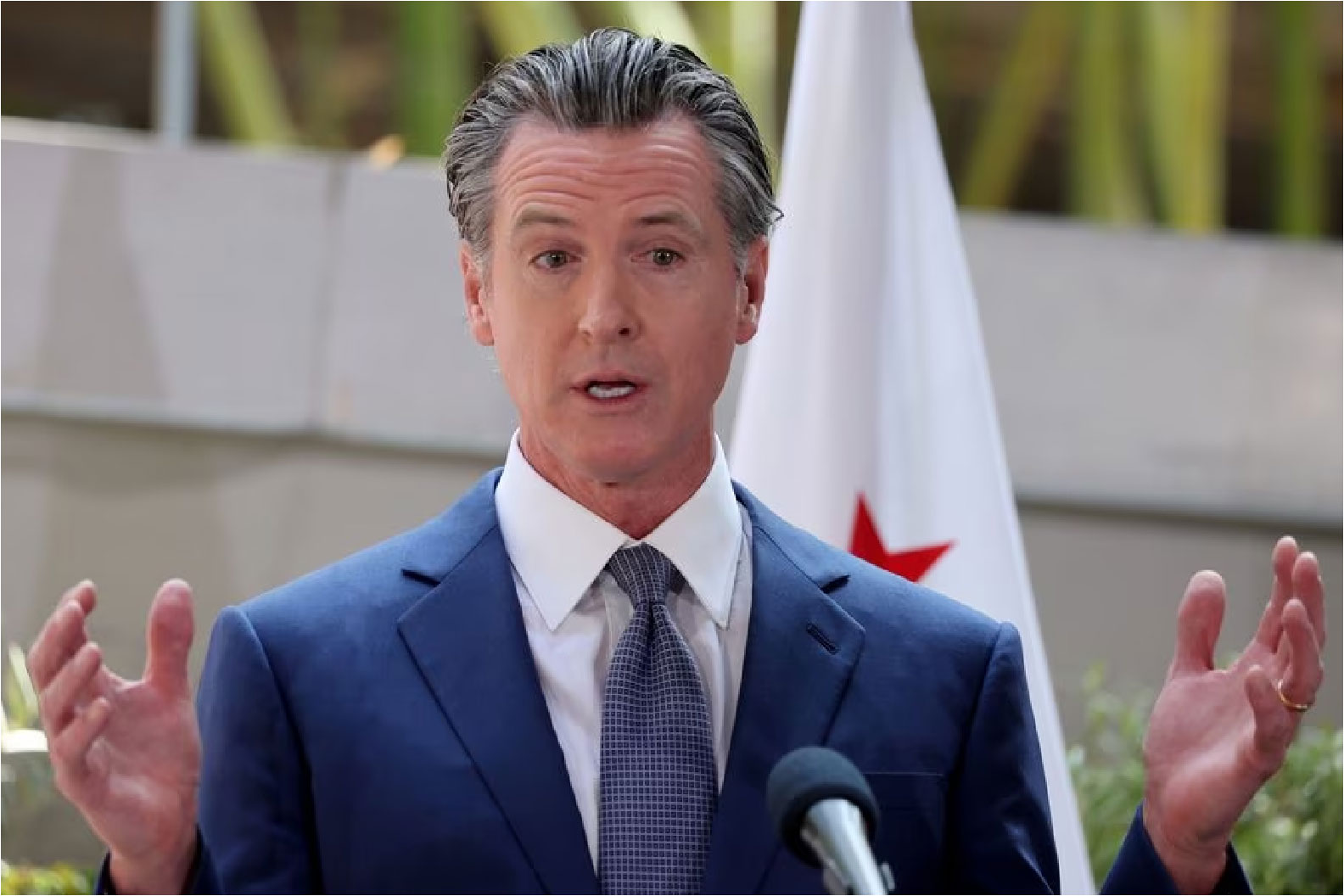
On Saturday, California Governor Gavin Newsom exercised his veto power to reject a recently passed bill by the state legislature aimed at explicitly prohibiting caste discrimination. Governor Newsom cited the existence of current laws that already prohibit discrimination based on ancestry, deeming the bill, officially known as Senate Bill 403 or SB 403, as “unnecessary.”
Governor Newsom’s veto represents a significant setback for activists who had been fervently advocating for the passage of this legislation. While U.S. discrimination laws already prohibit ancestry discrimination, they do not explicitly address the issue of casteism.
The California legislation in question specifically aimed to address the caste system within South Asian and Hindu immigrant communities by including caste as a protected category under the state’s existing anti-discrimination laws.
This bill, originally introduced and authored by Democratic state Senator Aisha Wahab, who is of Afghan American descent, initially passed by the state Senate but underwent subsequent revisions before reaching Governor Newsom’s desk for consideration.
The revised version of the bill, which incorporated caste under the category of “ancestry” rather than treating it as a distinct category, received approval from California’s state Assembly in late August and passed through the state Senate in early September with nearly unanimous support.
Governor Newsom, in a letter addressed to California state lawmakers and published on the governor’s office website, explained his veto decision by stating, “Because discrimination based on caste already prohibited under these existing categories. This bill is unnecessary.” Consequently, he declined to sign the bill into law.
Activists who oppose caste discrimination argue that it is akin to other forms of discrimination. Such as racism, and therefore should be expressly prohibited by law. On the other hand, opponents of the bill in California contend that since U.S. laws already prohibit ancestry discrimination. This specific legislation becomes redundant and only serves to unfairly stigmatize. The broader community, predominantly Hindus and South Asians.
Prior to Governor Newsom’s veto, the movement against caste discrimination had been gaining momentum in North America in recent months. Seattle became the first U.S. city to outlaw caste discrimination earlier this year through a city council vote. And Toronto’s school board became the first in Canada to acknowledge the existence of caste discrimination in the city’s schools.
In California itself, just last month, Fresno became the second U.S. city to ban caste discrimination following a unanimous city council vote. This issue holds particular significance for Americans of Indian descent and Hindus. With a growing population of Indians and South Asians in the U.S., especially in California and Silicon Valley. Some of the country’s largest technology companies have had to confront the issue of caste discrimination. Many of these tech firms are led by individuals of Indian origin. Such as Alphabet CEO Sundar Pichai, Microsoft CEO Satya Nadella, and IBM CEO Arvind Krishna.
The caste system is one of the world’s oldest forms of rigid social hierarchy, dating back thousands of years. It bestows numerous privileges upon upper castes while suppressing those in lower castes. The Dalit community occupies the lowest tier of the Hindu caste system and has historically been treated as “untouchables.” Newsom exercised his veto
Although India officially outlawed caste discrimination over 70 years ago. Several studies conducted in recent years reveal that bias still persists. These studies have shown that individuals from lower castes continue to be underrepresented in higher-paying jobs. Dalits in India continue to face widespread abuse. And their efforts to achieve upward social mobility have, at times, met with violent repression.