

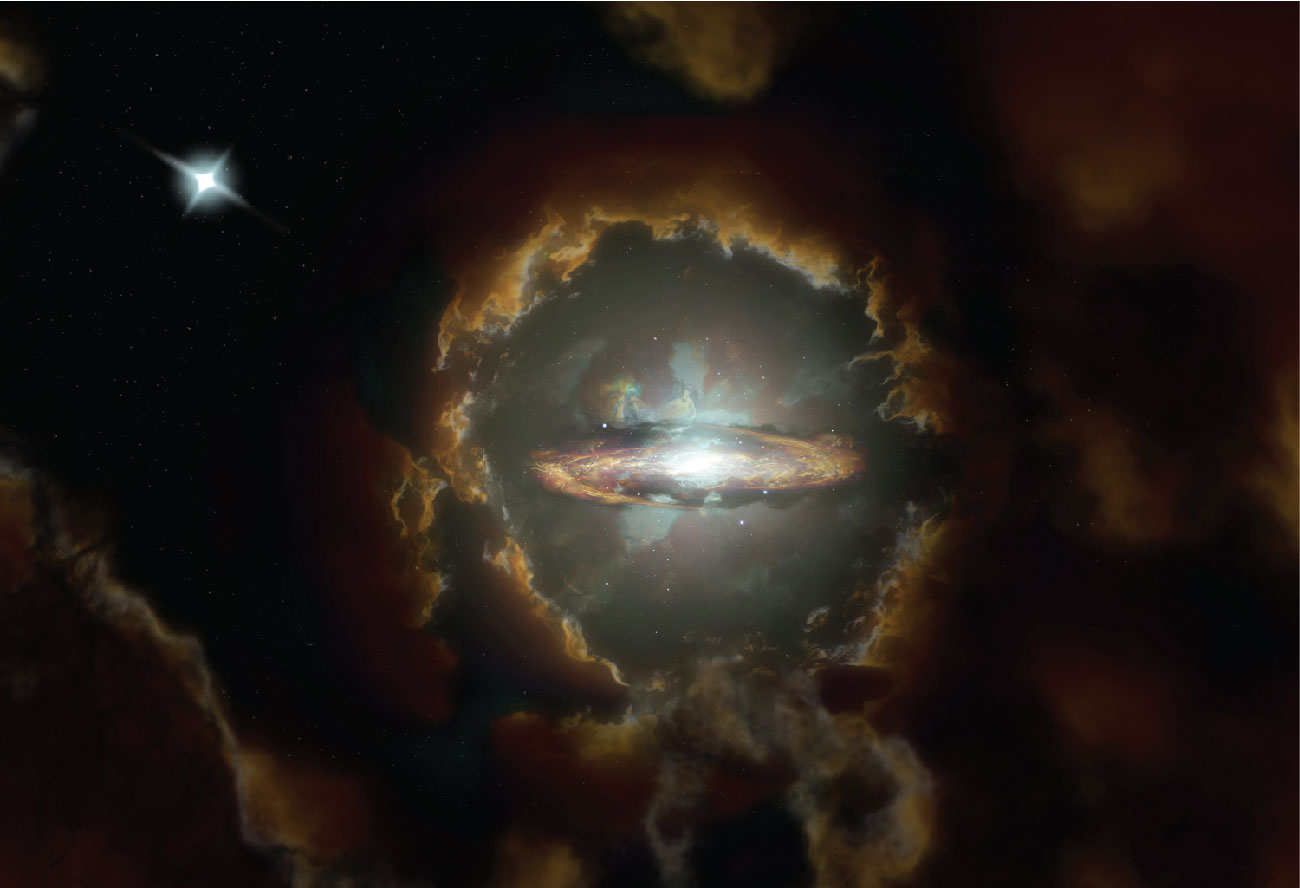
The early Universe was a wild time. In the first 2 billion years following the Big Bang 13.8 billion years ago, star formation positively roiled, and galaxies flared to life in the darkness, collided, and grew.
Deciphering the information conveyed by light over vast distances and time poses a considerable challenge, and our interpretations aren’t always accurate. Recently, the most advanced space telescope in operation uncovered a compelling instance of misidentification.
Initially identified in 2013 as a galaxy fueling intense star formation merely 880 million years after the Big Bang, HFLS3, as it turns out, is not a solitary galaxy. According to an analysis of data from the James Webb Space Telescope, HFLS3 is, in fact, a conglomerate of six galaxies engaged in a monumental collision at the cosmic dawn.
Conducted by astrophysicist Gareth Jones from the University of Oxford, the study revealing this cosmic revelation has been accepted for publication in Astronomy & Astrophysics and is accessible on the preprint server arXiv. The early Universe
HFLS3 perplexed scientists when it appeared in data from the Herschel space telescope. Situated at the inception of the Universe during the Epoch of Reionization, it exhibited a staggering star formation rate of around 3,000 solar masses per year, a remarkable contrast to the Milky Way’s production of approximately 8 solar masses annually, even though the two entities were presumed to have similar masses.
This phenomenon posed a challenge to understanding, as conventional wisdom held that galaxies couldn’t attain such substantial sizes and high rates of star formation in the early stages of the Universe. However, observations from Herschel, followed by Hubble observations, hinted at a more complex scenario, suggesting the possibility of multiple galaxies within the distant luminosity.
The James Webb Space Telescope, designed for unparalleled precision in exploring the deepest realms of space-time, provided astronomers with an unprecedented opportunity to scrutinize HFLS3 in greater detail than previously possible.
In September 2022, JWST’s near-infrared NIRSpec instrument took observations of the swatch of sky in which HFLS3 can be found, and Jones and his team fell on the data with gusto. And, once they processed the data and teased apart the way the light had warped as it traveled across the Universe, they realized there were signs of six distinct galaxies within.