

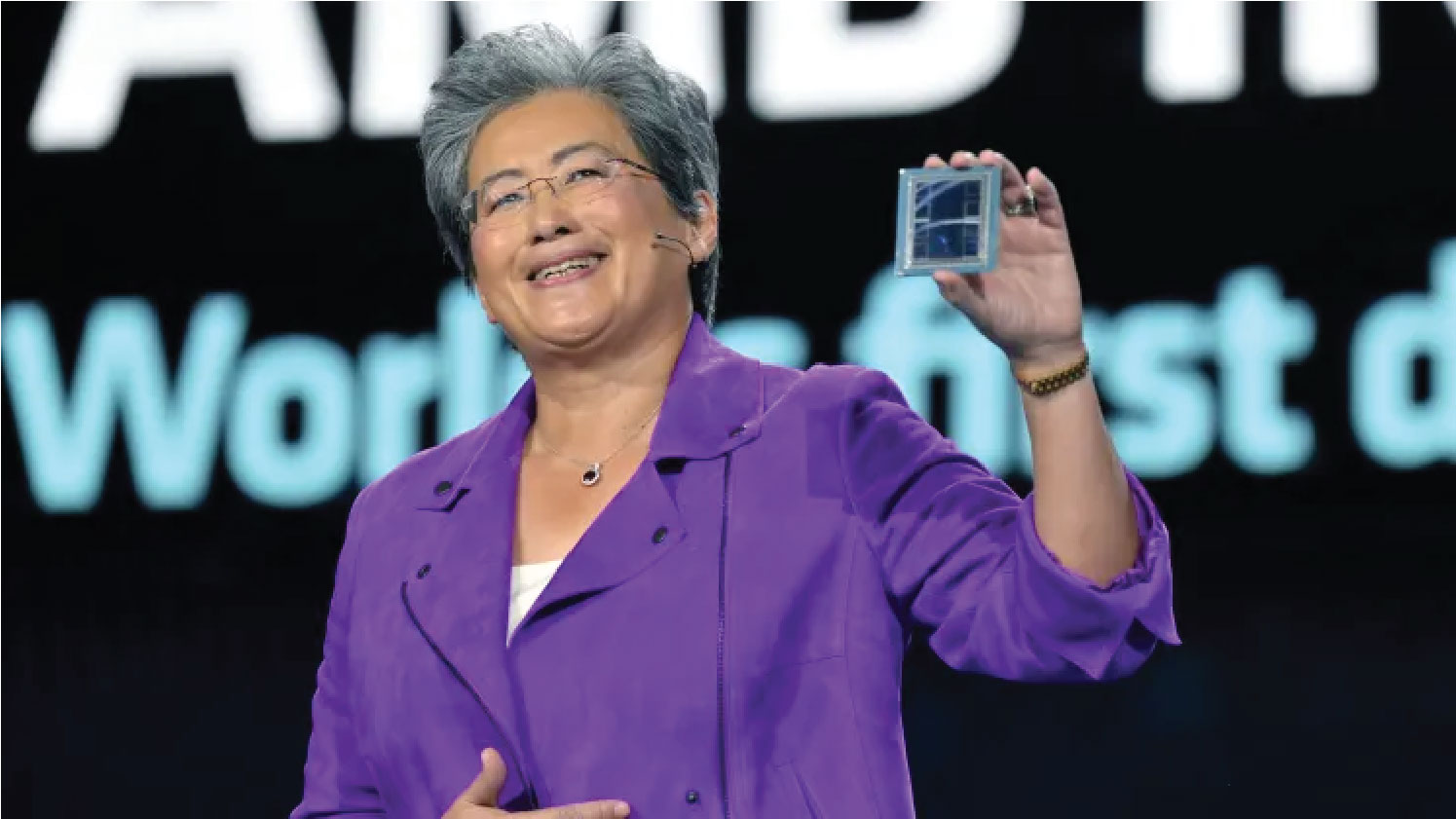
Meta, OpenAI, and Microsoft have announced at an AMD investor event that they plan to utilize AMD’s latest AI chip, the Instinct MI300X. This development signals a significant move by technology companies toward exploring alternatives to Nvidia’s graphics processors, which have traditionally been crucial for the development and deployment of artificial intelligence programs like OpenAI’s ChatGPT.
The adoption of AMD’s high-end chip by major technology and cloud service providers suggests a shift away from the expensive Nvidia GPUs. This move could potentially reduce costs associated with developing AI models and create competitive pressures on Nvidia, which has seen substantial growth in AI chip sales.
AMD’s MI300X is touted as being based on a new architecture, often indicative of notable performance improvements. One of its key features is its 192GB of high-performance memory, specifically High Bandwidth Memory 3 (HBM3). This type of memory facilitates faster data transfers and accommodates larger AI models, enhancing the capabilities of AI applications.
The interest from major players like Meta, OpenAI, and Microsoft in AMD’s AI chip suggests a growing trend in the industry to diversify the sources of hardware for AI applications and potentially reduce dependency on a single provider. Microsoft have announced
Lisa Su, CEO of AMD, made a direct comparison between AMD’s MI300X and Nvidia’s main AI GPU, the H100, highlighting the improved performance of the MI300X. She emphasized that the enhanced performance directly translates into a better user experience, particularly in scenarios where more complex AI models are involved. Faster response times become crucial as models handle increasingly intricate queries.
Despite the promising performance of AMD’s MI300X, the key challenge lies in convincing companies that have been reliant on Nvidia GPUs to invest the necessary time and resources to incorporate another GPU supplier. Lisa Su acknowledged that adopting AMD requires effort and investment, and the success of AMD in this space will depend on its ability to attract and retain clients in a market that has traditionally been dominated by Nvidia.