

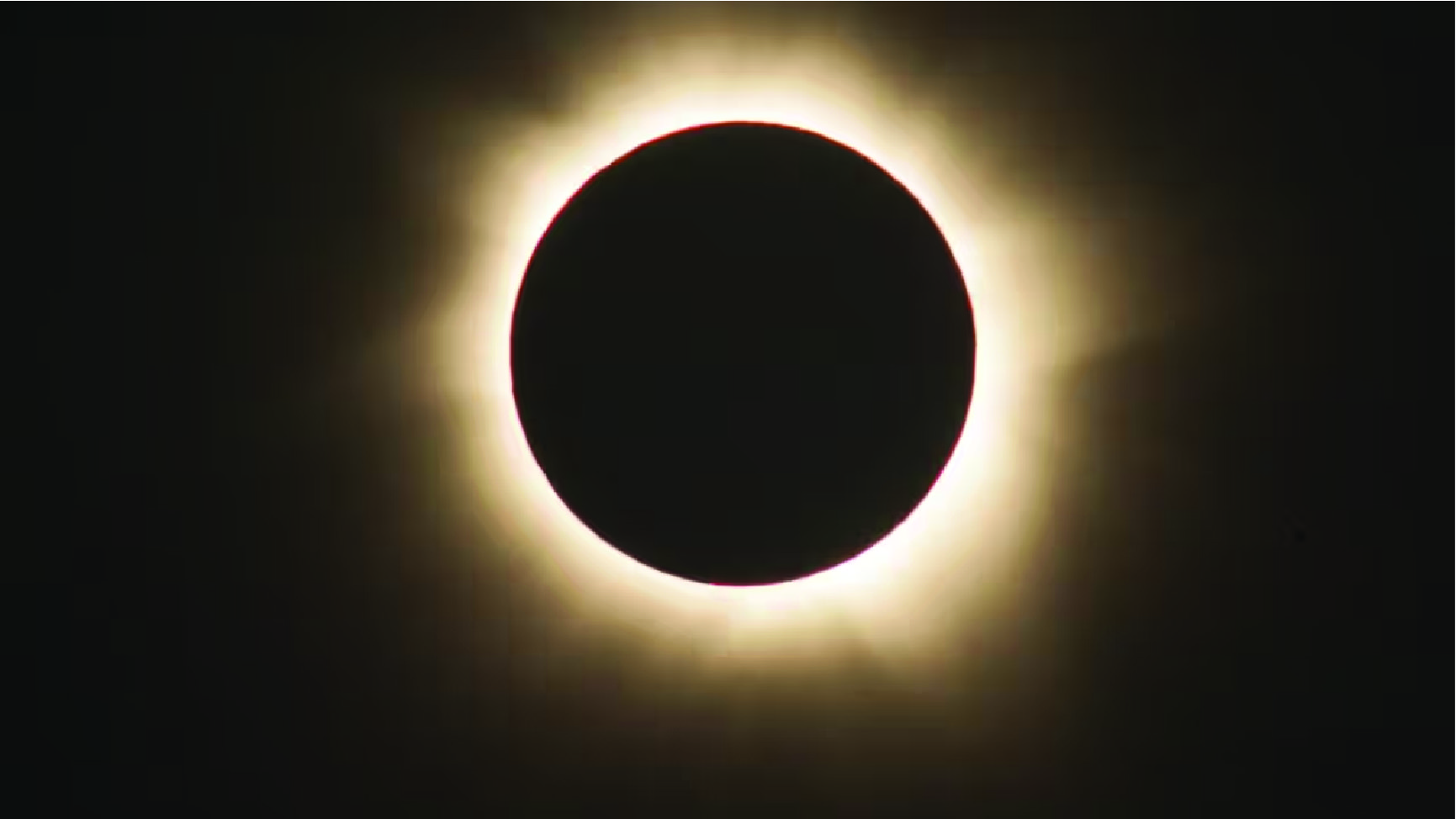
Your social media feeds might’ve been filled over the past couple of weeks with photos of the recent “ring of fire” annular eclipse, which crossed the western U.S. on Oct. 14. But it wasn’t just photographers who imaged the celestial event.
Researchers from the New Jersey Institute of Technology’s Center for Solar-Terrestrial Research (NJIT-CSTR) have achieved a groundbreaking feat by capturing the very first radio images of an annular solar eclipse. This remarkable achievement was made possible through the utilization of the Owens Valley Radio Observatory Long Wavelength Array (OVRO-LWA) in California.
The team harnessed a collection of 352 antennas designed to detect radio wavelengths spanning from approximately 20 to 88 megahertz (MHz). These instruments enabled them to capture images of the eclipse’s distinctive ring, which persisted for nearly an hour within the radio spectrum. In stark contrast, the traditional visible light experience of a solar eclipse, which is highly anticipated by solar enthusiasts, only lasts for a few minutes. This disparity arises from the fact that the radio sun appears to be approximately twice the size of the visible solar disk, offering a unique and extended perspective on this natural phenomenon.
Bin Chen, an associate professor of physics at NJIT-CSTR, highlighted their achievement, stating, “From our observatory site in California we were not in the belt to see the annular eclipse, yet we’ve been able to ‘see’ it all clearly unfold in radio, which reveals a much larger solar disk than its visible counterpart thanks to its sensitivity to the extended solar corona.” This underscores the unique capability of radio observations to provide insights into celestial phenomena that may not be visible to the naked eye, allowing for a deeper understanding of solar events like annular eclipses. Your social media
Ordinarily, the solar corona, the outermost layer of the Sun’s atmosphere, remains hidden from view from the Earth’s surface, with exceptions occurring only during a total solar eclipse, such as the one expected on April 8, 2024. However, the Owens Valley Radio Observatory Long Wavelength Array (OVRO-LWA) has ushered in a new era in solar observation. With this groundbreaking instrument, the solar corona is now visible to scientists continuously, eliminating the need to wait for rare total solar eclipses to catch a glimpse of this elusive region. Researchers are especially excited about the prospect of studying the solar corona during various eclipses, which will undoubtedly enhance our understanding of this enigmatic and dynamic component of the Sun.