

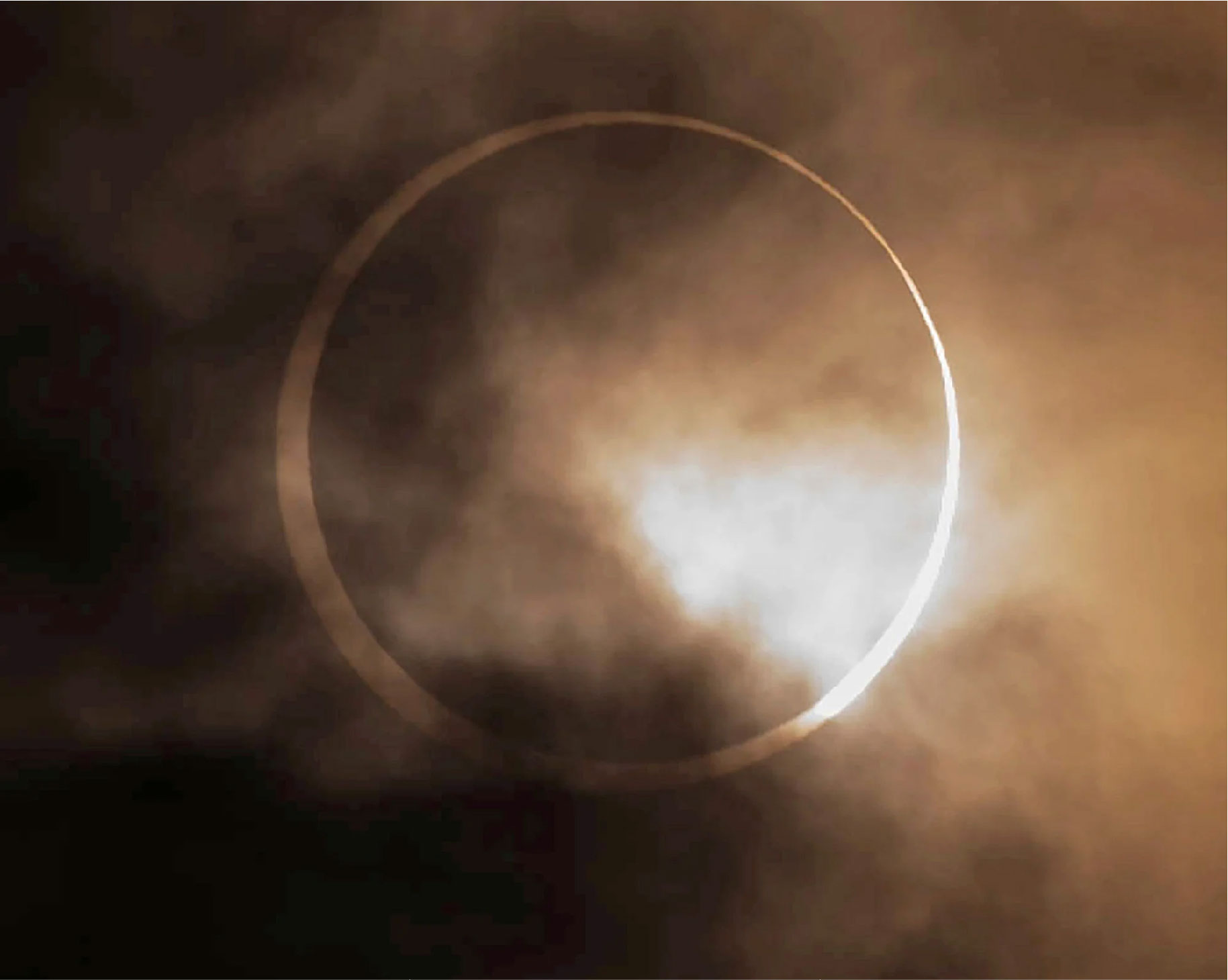
The eclipse that took place on Saturday, October 14, was an annular eclipse, signifying that the moon did not completely obscure the sun, resulting in a ring-like appearance of the sun around the moon.
For the second time in a span of six years, Oregon found itself within the path of a solar eclipse. The event that occurred on Saturday, October 14, was of the annular variety, meaning that the moon did not completely cover the sun. This unique celestial alignment resulted in a breathtaking “ring of fire” effect, which had eclipse enthusiasts eagerly anticipating the spectacle.
In contrast to the total solar eclipse of 2017, which took place in August and garnered significant attention, many parts of the state experienced cloudy conditions during the recent eclipse. These clouds either diminished or entirely obscured visibility of the celestial event.
Nevertheless, those who embarked on a journey to Klamath Falls were rewarded with a relatively clear view of this dramatic astronomical phenomenon.
Willamette Week relies, in part, on the support of its readers to fund their journalism. By becoming a WW supporter, you contribute to the sustainability of local, independent journalism that serves to inform, educate, and engage the community. Your support is invaluable in ensuring the continued presence and quality of their reporting.
The eclipse is set to grace the skies of several U.S. states, commencing at 09:13 PDT (12:13 p.m. EDT, 1613 GMT) in Oregon before making its way across Nevada, Utah, New Mexico, and then Texas. Additionally, the event will be observable from select regions of California, Idaho, Colorado, and Arizona before it eventually ventures into the Gulf of Mexico. moon did not completely
If you’re unable to witness the eclipse in person, you can still catch the spectacle online on Space.com, courtesy of NASA, beginning at 11:30 a.m. EDT (1630 GMT). For real-time updates and comprehensive coverage of the annular solar eclipse, you can follow along on our annular eclipse live updates page.