

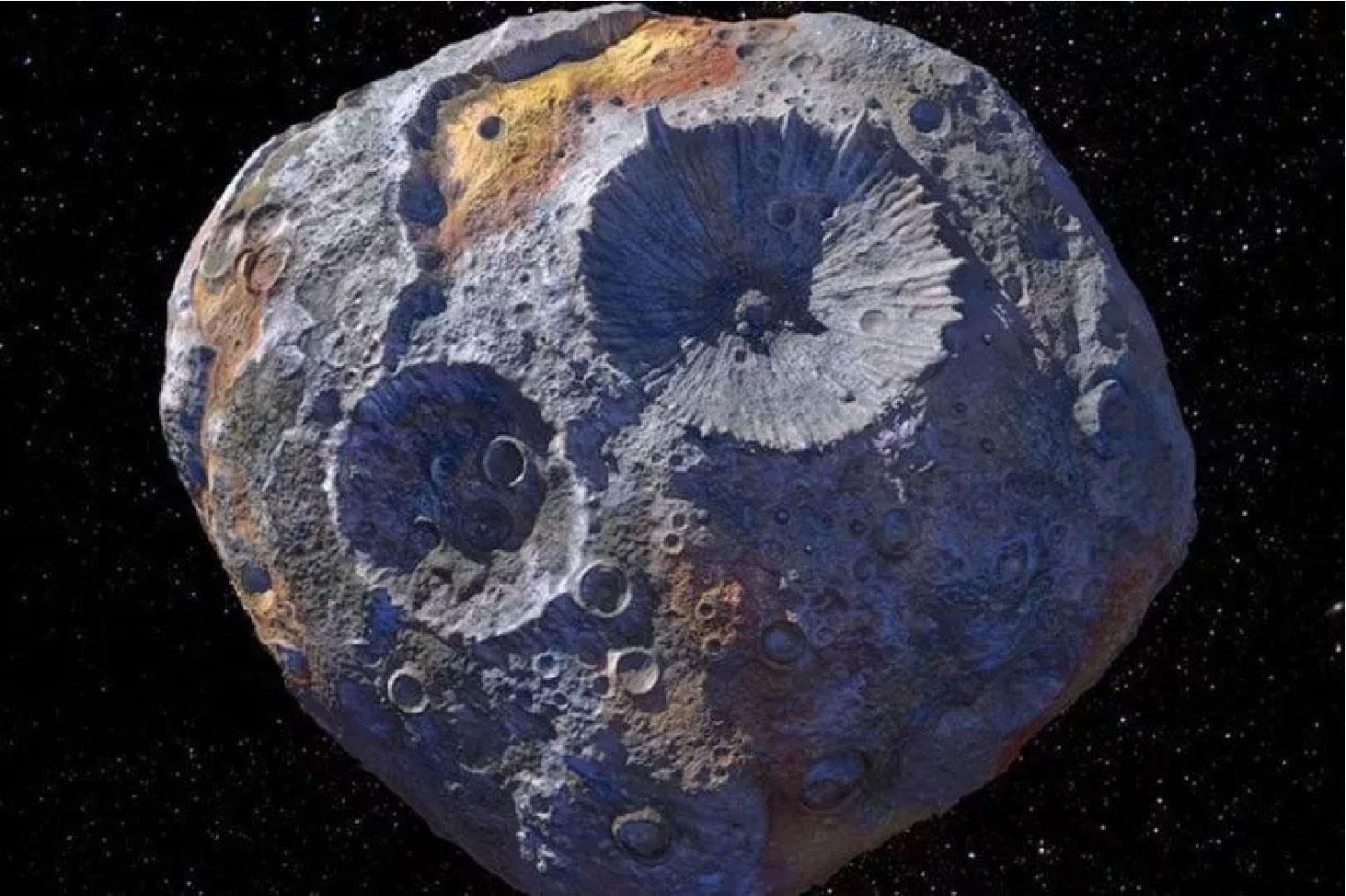
NASA’s most recent mission involved the launch of a rocket headed towards one of the most captivating objects in the main asteroid belt, which has the potential to make everyone on Earth extraordinarily wealthy.
On Friday, October 13, the space agency achieved a successful rocket launch aimed at reaching the metallic treasure trove known as 16 Psyche. This asteroid is not only rich in gold but also contains significant quantities of iron and nickel, with an astounding estimated total worth of $10,000,000,000,000,000,000, which is equivalent to $10,000 quadrillion or £8,000 quadrillion.
Should NASA successfully mine the asteroid and return its valuable resources to Earth, it would essentially render every individual on the planet a billionaire. However, in reality, executing such a plan would have catastrophic economic consequences, akin to if every person alive suddenly won the jackpot lottery.
Fortunately, NASA has made it clear that their mission does not revolve around asteroid mining. The space agency’s primary objective is to gain insights into planetary cores and the processes involved in planetary formation.
As stated in a NASA press release from July, “With less than 100 days to go before its launch, teams of engineers and technicians are working tirelessly to prepare the orbiter for a 2.5 billion-mile journey to a metal-rich asteroid. This mission promises to provide valuable knowledge about planetary cores and the mechanisms responsible for planet formation.”
According to NASA, the asteroid, 16 Psyche, follows an orbit around the Sun situated between Mars and Jupiter, spanning a distance that varies from 235 million to 309 million miles (378 million to 497 million kilometers) from our star.
Scientists anticipate that the spacecraft will rendezvous with the asteroid in July 2029 and receive a slight velocity boost when it passes Mars in May 2026. Earth extraordinarily wealthy
Upon achieving orbit around Psyche, the spacecraft will undertake a comprehensive study of the asteroid. This will involve the use of various specialized instruments, including a multispectral imager, a gamma-ray and neutron spectrometer, a magnetometer, and a radio instrument designed for gravity measurement, as outlined by NASA.