

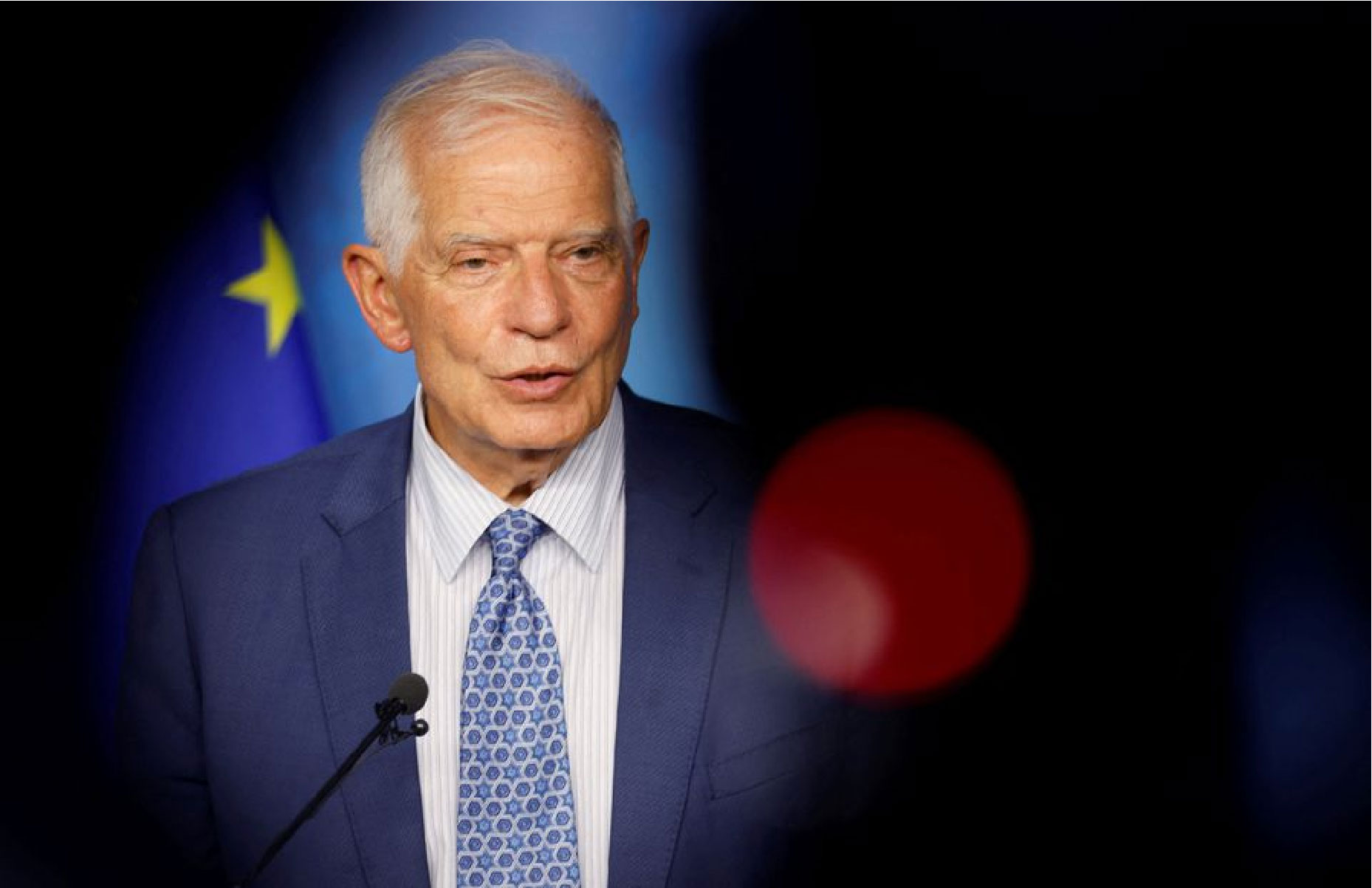
The European Union’s commitment to supporting Ukraine is not contingent upon short-term battlefield developments, emphasized the bloc’s foreign affairs chief on Monday.
Josep Borrell, the EU’s foreign affairs chief, underscored during a press conference held after a meeting of EU foreign ministers in Kyiv that their support for Ukraine is steadfast and enduring. He emphasized, “Our commitment is not swayed by daily progress; it is a consistent, structured form of support due to the existential threat Ukraine’s situation poses for Europe,” as reported by the Ukrainian state news agency Ukrinform.
He stressed that the European Union’s support for Ukraine remains unwavering, irrespective of the ongoing developments in the war in the coming days or weeks. He acknowledged the remarkable bravery displayed by Ukrainian soldiers facing formidable Russian defense fortifications.
Borrell also pointed out that satellite imagery revealed Russian fortifications extending as far as 25 kilometers (15.5 miles) deep into certain areas, as reported by Ukrinform.
The EU’s top diplomat further emphasized the need for Ukraine’s partners to provide the country with improved and expedited arms support if they wish to see Ukraine achieve greater success, as conveyed by Ukrinform.
Borrell’s visit to Ukraine commenced on Saturday and has included visits to the city of Odesa, paying tribute to fallen soldiers in Kyiv, and engaging in his first personal meeting with Ukraine’s Defense Minister, Rustem Umerov, as reported by Ukrinform.
The European Union (EU) is a political and economic union consisting of 27 European countries. It was initially established in the aftermath of World War II with the aim of fostering economic cooperation among European nations to prevent future conflicts and promote shared prosperity. The EU has since evolved into a complex and influential supranational organization.
1. **Member States**: As of my last knowledge update in September 2021, the EU comprised 27 member states. The United Kingdom left the EU on January 31, 2020, following a referendum in 2016. The EU continues to expand, with other countries expressing interest in joining.
2. **Single Market**: The EU operates a single market, which allows for the free movement of goods, services, capital, and people among member states. This has facilitated trade and economic growth.
3. **Euro Currency**: Nineteen of the EU member states have adopted the euro (€) as their official currency, forming the Eurozone. Other countries retain their national currencies.
4. **Institutions**: The EU has several key institutions, including the European Commission, the European Parliament, the European Council, and the Court of Justice of the European Union. These institutions are responsible for policymaking, legislation, and governance.
5. **Common Policies**: The EU has developed common policies in various areas, such as agriculture, fisheries, competition, and environmental protection. It also has a common trade policy negotiated on behalf of all member states.
6. **Human Rights**: The EU places a strong emphasis on upholding human rights and the rule of law. It has its Charter of Fundamental Rights, which sets out key rights and principles.
7. **Global Role**: The EU plays a significant role in international affairs, advocating for peace, climate action, and global cooperation. It is one of the largest economies in the world.