


NASA Astronaut Frank Rubio Returns to Earth
In a historic moment, NASA astronaut Frank Rubio has made his triumphant return to Earth, experiencing the planet’s gravitational pull after an absence of over a year.NASA astronaut Frank Rubio
Rubio, alongside his Russian counterparts, cosmonauts Sergey Prokopyev and Dmitri Petelin, descended via parachute to land in Kazakhstan aboard the Russian Soyuz MS-23 capsule. The momentous landing occurred at 5:17 p.m. local time (7:17 a.m. ET) on Wednesday.
This return marks the conclusion of an unexpectedly prolonged journey for Rubio, who initially had a mission duration of only six months aboard the International Space Station. However, due to the discovery of a coolant leak in his original spacecraft while docked to the orbiting outpost, Rubio’s space odyssey extended to an impressive 371 days.
Rubio’s Exceptional Achievements in Space
Frank Rubio’s extraordinary sojourn in microgravity has established a new milestone, setting a record as the longest duration a U.S. astronaut has ever spent in this weightless environment. Furthermore, he etched his name in history as the first American to complete an entire calendar year in orbit.
Rubio’s mission was marked by several remarkable firsts. Notably, it marked his inaugural space voyage after his selection into the NASA astronaut corps in 2017. At the commencement of this mission, he made history as the first astronaut of Salvadoran heritage to journey to low-Earth orbit.
Reflecting on his unprecedented mission, Rubio revealed in a recent CNN interview that had he known his stay on the space station would stretch to twice the initially planned duration, he “probably would have declined” the assignment before embarking on the rigorous training.
Rubio’s Personal Sacrifice for Space
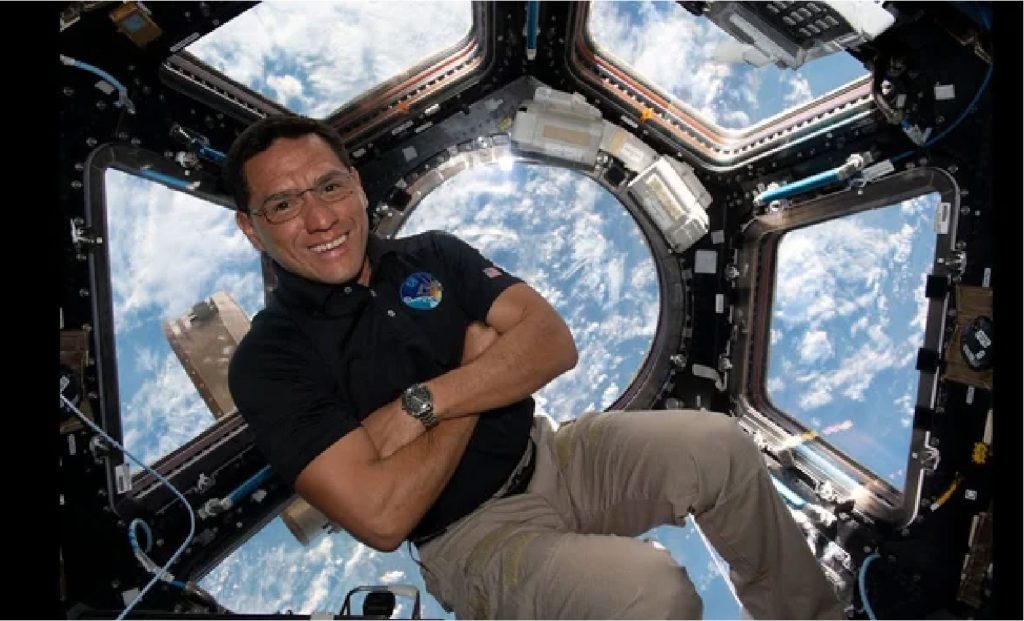
Rubio candidly shared, “And that’s solely because of family matters that transpired this past year. If I had been aware that I’d have to miss those profoundly significant events, I would have regrettably declined the opportunity, saying ‘thank you, but no thank you.'”
The dedicated astronaut, who is a father of four, is currently preparing to embark on the journey back home from the landing site of the Soyuz spacecraft, located in close proximity to the town of Dzhezkazgan in Kazakhstan. His itinerary involves an initial flight to Karaganda, situated approximately 330 miles (530 kilometers) northeast of Dzhezkazgan, followed by a subsequent flight to Houston.
Rubio’s Extraordinary Space Journey
In an astonishing feat, Rubio, along with his fellow crew members, covered a staggering distance of 157.4 million miles (253.3 million kilometers) during their mission, completing an impressive total of 5,963 orbits around our planet, as reported by NASA.
Rubio’s remarkable achievement surpassed the previous U.S. astronaut record for the longest stay in space, which stood at 355 days and had been set by NASA’s Mark Vande Hei in 2022. It’s worth noting that the world record for the longest continuous stay in space belongs to the late Russian cosmonaut Valeri Polyakov, who spent a remarkable 437 days aboard Russia’s Mir space station between January 1994 and March 1995.
This mission demonstrated the enduring collaboration between the United States and Russia in space exploration. Rubio’s journey to the International Space Station took place through a ride-sharing agreement between NASA and Roscosmos, the Russian space agency. This agreement was established in the summer of 2022 amid Russia’s invasion of Ukraine, ensuring continued access to the space station for both countries in the event of spacecraft issues that could ground their astronauts.
Rubio, along with Prokopyev and Petelin, embarked on their space odyssey aboard the Soyuz MS-22 vehicle on September 21, 2022, safely arriving at the ISS just three hours later. Their Soyuz capsule remained docked to the space station’s exterior as they conducted their vital work on the orbiting laboratory.
In a recent interview, Rubio expressed heartfelt gratitude to his family, acknowledging their unwavering support, which had been a source of strength throughout his entire mission.
The mission encountered a significant challenge less than three months in when the Soyuz MS-22 began experiencing coolant issues. Investigations led by Roscosmos, later reviewed by NASA, pointed to the spacecraft being likely struck by a small object in orbit. The culprit was identified as either a micrometeorite or a fragment of orbital debris, highlighting the mounting risks posed by space debris in the increasingly congested low-Earth orbit environment. Subsequently, the Soyuz MS-22 was deemed unsuitable for the astronauts’ return, prompting Roscosmos to swiftly launch a replacement vehicle, the Soyuz MS-23, in February.
A Prolonged Stay in Orbit
Rubio and his colleagues faced an unexpected extension of their mission as officials determined that they would remain in space while Roscosmos readied yet another Soyuz capsule to launch a fresh crew as replacements.
The eagerly awaited Soyuz MS-24 vehicle finally became operational this month, carrying NASA astronaut Loral O’Hara alongside Roscosmos cosmonauts Oleg Kononenko and Nikolai Chub to the space station on September 15. This mission paved the way for Rubio’s long-awaited return on Wednesday.
Rubio, a seasoned medical doctor and military helicopter pilot with over 600 hours of combat experience, acknowledged that his reintegration into life on Earth might not be immediate due to the physical effects of extended exposure to microgravity.
Rubio, a seasoned medical doctor and military helicopter pilot with over 600 hours of combat experience, acknowledged that his reintegration into life on Earth might not be immediate due to the physical effects of extended exposure to microgravity.
Rubio, a seasoned medical doctor and military helicopter pilot with over 600 hours of combat experience, acknowledged that his reintegration into life on Earth might not be immediate due to the physical effects of extended exposure to microgravity.NASA astronaut Frank Rubio
He remarked, “We’re not walking, we’re not bearing our own weight (while in space), and so it’ll be anywhere from two to six months before I essentially say that I feel normal.”
Despite the adjustment period ahead, Rubio eagerly anticipates the simple joys of terrestrial life, saying, “Up here we kind of have the constant hum of machinery that’s keeping us alive, and so I’m looking forward to just being outside and enjoying the peace and quiet.”
NASA looking for ‘space tug’ ideas to bring space station back to Earth